

11 Ways to Make Better Insurance Decisions for Your Properties
Financial PlanningBy Cynthia Meyer, CFA®, CFP®, ChFC®
What you will get from this article:
For many real estate investors, insurance is treated like a necessary expense, rather than a strategic decision. It’s easy to look at insurance as an expense to minimize, revisit once a year, and only think about it once a claim happens.
The problem is that the focus tends to be on keeping premiums low, not on understanding what the coverage is actually designed to do.
Insurance isn’t a savings vehicle or something that you pay into with the expectation that you will “get your money back”. It’s a partnership that can help to protect against outcomes that would be financially disruptive (events that could significantly impact your portfolio, liquidity, or lifestyle).
In this article, we’re going to walk through 11 ways to make better insurance decisions for your properties as a real estate investor, so you can think more strategically about coverage, reduce avoidable costs, and better protect the assets you’re building.
#1. Understand What Insurance Is (And Isn’t)
Before looking at specific strategies, it’s worth taking a step back to really understand what insurance is meant to accomplish in the first place.
Many people think insurance is a place they put money in over time and should eventually get back. That’s not really how it works. Insurance is a tool that allows you to decide which risks you’re willing to take on yourself and which risks you want to transfer to someone else.
You pay a premium to your insurance company so that if something significant happens — something large enough to meaningfully affect your finances — you’re not forced to absorb that loss on your own.
The purpose of insurance isn’t to cover every minor expense or inconvenience, but to protect against events that could impact your balance sheet or force a change in your lifestyle. In the context of real estate, those risks are usually tied to the physical assets themselves, like fires, severe weather, or other major forms of damage that could need substantial capital to repair or rebuild.
When you understand how insurance really works, it’s easier to evaluate coverage decisions and decide what you’re actually trying to optimize for.
#2. Start Thinking of Your Insurance Company as Your Partner
Insurance is not just an expense you’re forced to pay. When you look at insurance as a strategic relationship, it helps reframe what you’re paying for and allows you to make the most of your coverage.
Buying an insurance policy is like having someone step in and take severe risks off your shoulders. It gives you the peace of mind of knowing that you don’t have to worry about coming up with hundreds of thousands of dollars to rebuild or repair properties in the event of a catastrophe.
A benefit of having a strategic partnership with your insurance provider is that you can define what the relationship means for you. You can change the amount you’d like to insure versus what risk you’d like to retain, you can shop around for new partners, and you can adjust this over time.
Another benefit of having insurance as a partner is that you have an experienced team on your side. They’re experienced in the field, and they bring their own expertise on liabilities and legal proceedings that would likely be difficult to manage on your own.
When you’re looking at your insurance options, you’re not just buying coverage, but structuring your overall risk.
#3. Customize Risk (Don’t Just Accept Default Coverage)
 Once you understand that insurance is a way to share your risk, you can decide what level of coverage works best for your unique situation.
For example, if you opt for a policy with a lower deductible, the insurer is taking on more of the risk, and your rates will reflect that. On the other hand, if you have a higher deductible, you take on more of the risk.
Deciding what the right level of coverage for you is depends on your circumstances. A good question for a real estate investor to ask themselves is: What level of loss would actually impact your lifestyle?
While many people look through the lens of trying to get the lowest possible premium, it’s important to consider your overall financial resilience when comparing options.
#4. Choose Deductibles Strategically
A common mistake that real estate investors make is choosing a lower deductible “just in case” they have an event come up that they’d want to avoid paying for out of pocket. In reality, the more claims you have, the higher your long-term cost of insurance is going to be.
As an insurance consumer, we urge you to think about how much risk you can take on before an event would cause a notable change in your lifestyle.
Insurance companies have an estimate of how much it would cost to insure you; the more risk they take on, the more it’s going to cost them. They then have to consider their internal expenses, agent commissions, and other costs that ultimately go into the rates they charge.
The more claims that are expected to be sent off to the insurer, the more they’re going to charge you to cover these expenses. Taking on small, manageable risks yourself can help you save on the expenses passed down to you.
A lot of this is dependent on your portfolio size, liquidity, and experience, but it’s important to understand that deductibles and claims are directly connected, and lowering deductibles isn’t necessarily the “cheapest” option.
#5. Shop Around Regularly
There are thousands of insurers out there, with constantly changing management and internal strategies. While not every provider will provide every type of insurance, there are typically plenty of options to consider before locking in on a policy.
It’s also important to do this on a regular basis. You may fit a company’s “ideal customer” at one point, and not the next. Executives retire on a regular basis, and replacements may have an entirely different direction in mind.
Shopping regularly is a great way to increase your options for a great deal.
#6. Avoid Over-Claiming
 As we’ve alluded to before, a common mistake investors make is using insurance too frequently.
Insurance isn’t designed to cover every small issue that comes up. It’s meant to protect against larger, less frequent losses that would be difficult to absorb on your own. When claims are made regularly, especially for smaller amounts, it can change how insurers view you as a policyholder.
Over time, this can lead to higher premiums or, in some cases, the risk of non-renewal altogether. From the insurer’s perspective, frequent claims may appear to be a lack of maintenance or risk management from the policyholder.
That’s why it’s important to be selective about your claims. Rather than filing claims for minor repairs and manageable losses, it often makes more sense to reserve insurance for more significant events where the financial impact would have a material effect.
#7. Make Sure You’re Not Underinsured
Another way to make better insurance decisions for your property is to make sure you have enough coverage.
At first glance, it can seem like a reasonable tradeoff to lower coverage to reduce insurance costs, but that approach doesn’t usually work out the way investors expect.
Insurance policies are typically structured around what’s known as “insurance to value”, meaning coverage is based on the full replacement cost of the property. Insurers generally require this level of coverage, and attempting to insure below that threshold can lead to limitations or penalties in how claims are handled.
More importantly, underinsuring a property exposes you to the very type of risk that the insurance is meant to protect against in the first place.
#8. Pay Attention to Property-Specific Risk Factors
 Insurance costs aren’t one-size-fits-all for any property you want to insure. There are many factors that can influence the cost of your policy.
Things like construction type (and materials used), distance from a fire station and hydrant, and geographical location all play a role in what the insurance provider expects they may have to cover.
For example, if you live in an area prone to flooding, there is a greater risk involved than in an area with a decreased risk of floods. These factors all influence the economics of the deal.
These aren’t things that real estate investors always consider when acquiring a property, but they do have a meaningful impact on the amount of insurance that you may need and the cost of that insurance.
#9. Understand What Coverage You Have
Within homeowners', landlord, or business owners' policies, there are some coverages that are often overlooked.
One of the most important examples of this is liability coverage, which covers you in the event that someone is injured on your property. Since these things don’t happen very often, the coverage isn’t very expensive, but the peace of mind that comes with this coverage is valuable to many investors.
Another example of this is workers' compensation for household help. If you hire a nanny or a housekeeper and they injure themselves, you, as the homeowner and employer, are responsible for their workers’ compensation claim.
Having a partner to help cover that risk and manage the situation for a relatively small amount of money can be a great help for many homeowners.
This is a situation where really reviewing your policy and speaking with your agent to understand what’s included is key. There may be areas where you have more or less coverage than expected, and you’ll want to plan accordingly.
#10. Add Strategic Coverage Where It Matters Most
Beyond your core coverage, there are a few areas where adding the right type of insurance can significantly strengthen your overall risk protection, and often at a relatively low cost.
 Umbrella Insurance
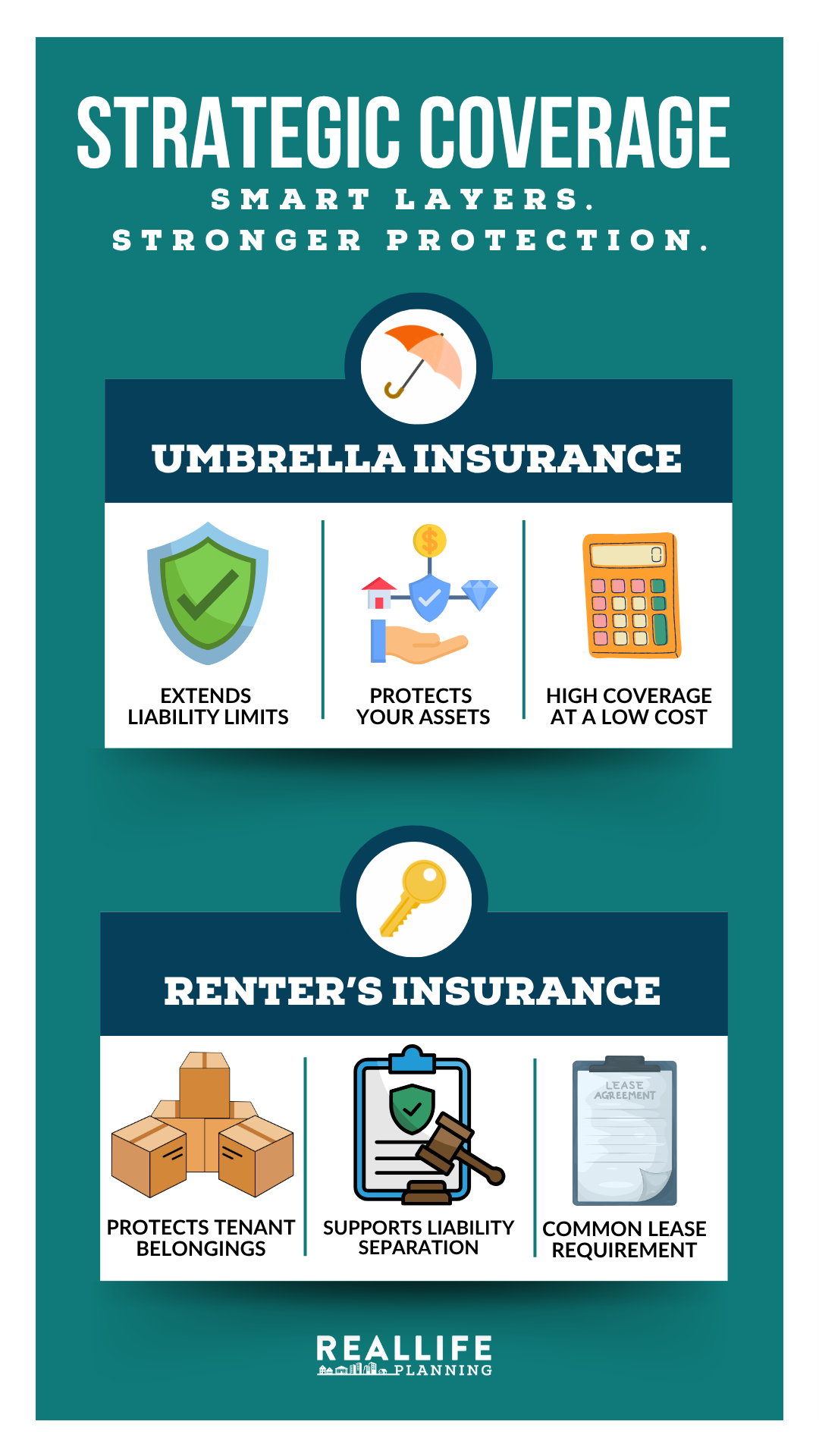
Umbrella insurance provides additional liability coverage on top of your existing policies. In many cases, standard homeowner or landlord policies include liability limits, but those limits may not be enough in the event of a larger claim. Umbrella coverage extends that protection (often by $1 million or more), creating an additional layer of protection.
One of the key advantages here is cost efficiency. Because large liability claims are relatively infrequent, umbrella coverage tends to be inexpensive compared to the amount of protection it provides. That makes it particularly valuable for property owners and higher-net-worth investors, where potential exposure may be greater.
Renter’s Insurance (for Tenants)
Another often overlooked area is renter’s insurance. While a landlord’s policy covers the structure of the property, it does not cover a tenant’s personal belongings. Renter’s insurance is designed to fill that gap in coverage.
It can also provide an additional layer of liability protection. If an incident occurs within a tenant’s unit, like an injury, having renter’s insurance in place may reduce the likelihood that the landlord is the primary party pursued for damages.
For that reason, many landlords choose to require renter’s insurance as part of their lease agreements.
#11. Review and Structure Your Policies Annually
Our last tip to help you make better insurance decisions for your property is to regularly (annually) review your coverage.
Sometimes policies will be in place but won’t have all of the parties covered, so it’s crucial for investors to ensure that everybody who needs to be covered is included in their policy as what’s called “additional insured”. For example, you’ll want to make sure property managers and any other lenders that should be additionally insured are in there.
Reviewing your policy regularly can also help you make sure you don’t have additional gaps or outdated coverage, and can be a great risk management discipline.
Insurance planning is part of your overall real estate strategy
Insurance is one of those areas that’s easy to overlook until you need it. The way you approach your insurance decisions as a real estate investor has a direct impact on how well your portfolio is protected over time.
Rather than focusing only on cost or treating it as a routine expense, it’s important to understand how insurance fits into your overall strategy. It’s there to protect against the kinds of outcomes that could disrupt your finances and lifestyle.
Insurance is a strategic partnership that helps you to structure the risk that comes with owning property. Instead of trying to optimize for the lowest premium, we encourage you to consider what level of risk you are willing and able to keep, and which risks you’d need to transfer.
If you’re a real estate investor thinking about how insurance fits into your overall financial plan, we’d love for you to check out more from the Real Life Blog and email us at podcast@reallifeplanning.com with any questions.

This blog is for general financial education purposes. Information contained in this blog should not be construed as financial, tax, real estate, legal, or investment advice. For educational purposes, blog posts may contain links to other websites which are not under the control or and are not maintained by Real Life Planning. Real Life Planning has provided those links for your convenience but does not necessarily endorse all the material on those sites. Please consult your financial, real estate, legal, or tax advisor for advice specific to your situation.