

Are You Ready to Scale Your Real Estate Portfolio?
Real Estate CoachingMost real estate investors find themselves at a point where they ask: What’s next?
We hear from clients every day, wondering if they’re ready to scale their real estate portfolio. They want to do more in an effort to become financially independent and work-optional. They’re active investors who have set up a good foundation for themselves and are looking for the next step.
Along with that ambition, however, there’s usually some underlying tension:

- “Am I moving fast enough?”
- “Where will I find funds for my next down payment?”
- “Can I still scale with today’s mortgage rates?”
- “Am I going to get in over my head?”
They want to scale their portfolio, but understand that real estate investing isn’t a “get rich quick” scheme. They want to make sure they’re scaling sustainably before taking on more complexity, more leverage, or larger deals.
For a real estate investor looking to scale, it’s worth taking a step back and asking yourself coaching four questions that can help you determine whether you’re actually ready for the next stage.
But first, let’s talk about what scaling means to different investors.
What Does It Actually Mean to “Scale” a Real Estate Portfolio?
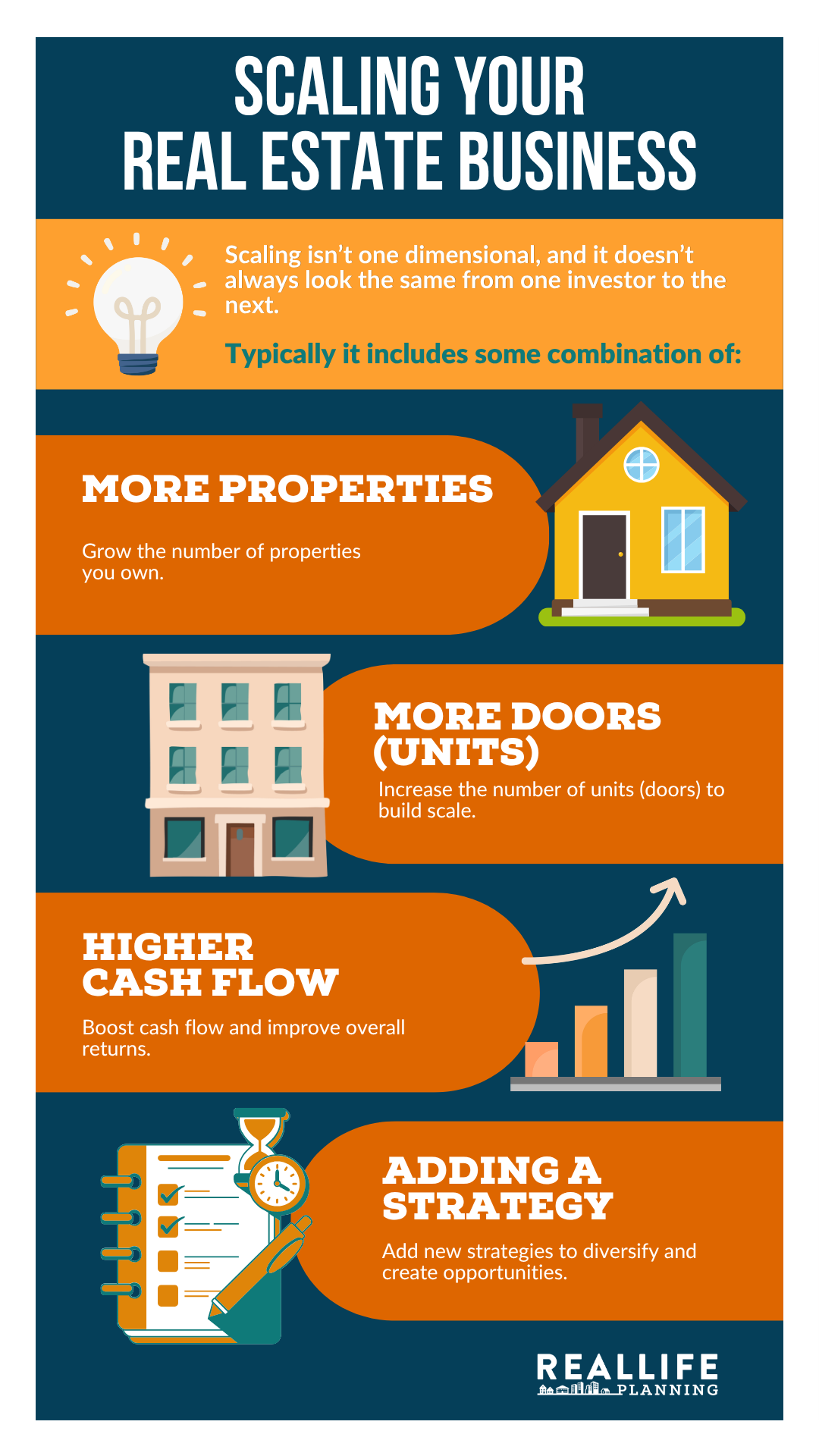 Scaling isn’t one-dimensional — and it doesn’t always look the same from one investor to the next. Typically scaling a real estate business includes some combination of:
- More properties
- More doors (units)
- Higher cash flow
- Adding a strategy
In practice, scaling can mean increasing complexity across multiple areas at once.
Asset Complexity
One way that many investors look at scaling is by evolving the complexity of their assets. A lot of investors will start with single-family homes, then gradually move into multi-unit properties or even commercial assets. This can include mixed-use buildings, storage facilities, or small office properties. Each of these brings its own set of considerations for investors.
Deal Size and Volume
Scaling can also mean increasing the number of properties acquired at once or expanding the total number of “doors” in a portfolio. Instead of purchasing one property at a time, investors may reach a point where they begin evaluating larger transactions or package portfolio deals.
Development Projects
Another thing that investors may consider when looking at scaling is the projects they may take on. As investors grow, they may take on more involved projects, from cosmetic updates to full-scale renovations or gut rehabs. These projects typically entail more coordination, more capital, and involve a higher chance of making mistakes.
Financing Complexity
Larger or more complex deals often require different financing structures than the traditional Fannie Mae or Freddie Mac conforming loans. Investors may want to go beyond traditional conforming loans into non-qualified or portfolio lending, which typically involves more detailed underwriting, documentation, and lender requirements.
The application process, at the portfolio-lending level, is more complex; inspections are often more expensive, repairs cost more, and there are generally more “hoops” to jump through at this level.
Before You Scale, Define Your End Goal
Before thinking about how to scale, it’s important to step back and get clear on what you’re actually working toward.
It’s easy to focus on the number of properties you own or the number of “doors” in your portfolio, but those metrics, on their own, don’t necessarily reflect progress toward your unique goals.
Instead, the focus should be on what those properties are producing. For many investors, that means looking at total net cash flow — how much income the portfolio is generating after expenses — and how that supports what they’re looking to accomplish in the long run.
The 4 Questions to Ask Before You Scale Your Real Estate Portfolio
Once you’ve defined your goals and understand what scaling actually involves, the next step is deciding whether you’re truly prepared to take it on. These are four questions that we want you to ask yourself to see if you’re ready to grow your real estate portfolio.
1. Are You Financially Ready to Scale?
As you begin to scale, the financial requirements increase… often more than investors initially expect.
Larger or more complex deals typically need more capital across the board, including down payments, renovation costs, and cash reserves. And as the size of the investment grows, so does the importance of having a large enough financial cushion in place.
At the same time, lender expectations tend to become more rigorous at this stage.
You may be asked to:
- Provide more detailed financial documentation
- Demonstrate stronger liquidity
- Show a clearer picture of your overall financial position
What may have been a relatively straightforward process for smaller properties can become significantly more involved as you expand your real estate business.
Insurance is another area where complexity often increases for investors. As you move into larger or more specialized assets, it may make sense to go from a standard policy with a direct agent to a more customized approach through an insurance broker.
All of this is to reinforce the idea that scaling isn’t just about investing in larger opportunities. It’s about operating at a higher level of financial readiness to take on more of an investment.
2. What Does Your Real Estate Investing “Resume” Look Like?
As you begin to scale, your experience becomes a larger part of the equation — especially from a lender’s perspective.
In many cases, lenders aren’t just evaluating the deal you’re financing; they’re evaluating you.
They want to understand your track record over the past several years: how many properties you own, how you’ve managed them, and whether you’re approaching real estate as a business rather than a side project.
This is where the idea of an “investing resume” comes into play.
It’s not a formal document, but it reflects your experience, your decision-making, and your ability to execute. And it carries more weight than investors usually expect.
For those earlier in their investing journey, this can feel like a barrier, but it’s also something that can be built intentionally over time. That typically starts with smaller, more manageable deals, and as you gain experience, you begin to establish a track record that makes future opportunities more accessible.
You can also strengthen your position by surrounding yourself with the right people. Working with experienced partners, building relationships with professionals, or leveraging relevant experience from your career can all help reinforce your credibility to lenders.
3. Do You Have the Right Real Estate Team?
 As you scale, your reliance on other people increases, especially if you’re a newer investor.
What may have been manageable on your own at a smaller level becomes much more complex as your deal sizes, project scopes, and geographic reach expand. At that point, having the right team in place is what’s going to help you navigate your growth as an investor.
That team often includes key partners who are real estate savvy and investor-friendly:
- Realtor®
- Contractor
- Lender
- Property manager
- Tax advisor
- Insurance specialist
- Home inspector
- 1031 Qualified intermediary
- Attorney
Each plays a different part in helping you evaluate opportunities, execute effectively, and manage risk.
One important nuance to keep in mind is that the team that helped you get started may not be the same team that can support you as you grow.
A contractor who handles smaller cosmetic projects may not be equipped for a full-scale renovation. A CPA who prepares basic returns may not be the right fit for more advanced tax strategies like a complicated cost segregation study. As your investments become more complex, your team often needs to evolve alongside them.
Geography also plays a role here. If you expand into new markets, you may need to build local relationships — particularly on the operational side. While some members of your team can support you across locations, others, like contractors and property managers, are often market-specific and can’t be replicated remotely.
This is also where working with a financial planner who specializes in real estate can add significant value. As you begin to scale, decisions around leverage, tax strategy, cash flow planning, and overall portfolio structure become more interconnected. Having someone who can look at the full picture — not just individual deals — can help ensure that each decision supports your broader financial goals.
4. Do You Fully Understand the Opportunity and the Risks?
As properties become larger or more complex, the decision-making process becomes much less straightforward.
In some cases, the challenge isn’t what’s in front of you, but what might not be obvious that could potentially come up. And the larger the property, the more unknowns there tend to be. That’s why it becomes especially important to evaluate how sensitive the deal is to changing conditions and run a “what if” model.
What happens if interest rates move? If renovation costs come in higher than expected? If taxes move in either direction? Looking at both best-case and worst-case scenarios can help create a more realistic view of how the investment may perform and if it makes sense for you.
There are also practical risks that may not be obvious at first glance. Unfinished maintenance, poor prior management, and other hidden expenses can all materially impact the outcome of a deal — especially if the property hasn’t been professionally run or well documented.
Financial records may be incomplete, inconsistently maintained, or difficult to verify. That means investors often have to make more assumptions, which introduces more uncertainty into the decision-making process.
For that reason, a conservative mindset is really important to anticipate risk.
When information is limited, or assumptions are made, it’s generally better to err on the side of caution. Scaling successfully doesn’t mean assuming things will go smoothly; it more often means recognizing where there’s uncertainty and planning accordingly.
Leverage and Local Knowledge
As you think about scaling, there are a few additional factors that can significantly impact both risk and long-term outcomes.
Your Leverage Strategy
Scaling a real estate portfolio often means increasing your use of leverage, but how much leverage is appropriate isn’t a one-size-fits-all decision.
It requires a clear understanding of your risk tolerance, liquidity, and overall financial position. For some investors, higher leverage may accelerate growth. For others, it may introduce more volatility than they’re comfortable with.
Your approach should also reflect your life stage and broader financial goals. An investor focused on aggressive growth may make different decisions than someone prioritizing stability or income.
Taking the time to define these parameters upfront can help you make sure that your growth strategy is a fit with your capacity to manage risk, not just your aspirations to scale.
Why Local Knowledge Matters More as You Grow
As you expand into new markets, local knowledge also becomes increasingly important.
While high-level data can help identify potential opportunities, it often doesn’t capture the nuances that impact day-to-day performance: things like maintenance expectations, tenant demand, and cost structures within a specific area.
Investors who can concentrate their efforts within a smaller number of markets often benefit from a compounding effect where each additional property builds on the knowledge gained from the last. That familiarity with a specific market can lead to better decision-making over time.
On the other hand, spreading too thin across multiple geographies can dilute that advantage and introduce additional complexity without the right local support.
Scaling Is a Strategy, Not a Milestone
It’s easy to think about scaling in terms of numbers, like how many properties you own or how quickly you’re acquiring them. But those metrics, on their own, don’t define success.
Scaling isn’t about collecting more assets or pressing the gas on your pace. It’s meant to be about building a system that can support your real estate portfolio’s growth and manage increasing complexity.
Before taking the next step, it’s worth revisiting the 4 questions we’ve talked about:
- Are you financially ready?
- Do you have the experience to execute effectively?
- Do you have the right team in place?
- Do you fully understand both the opportunity and the risks?
These aren’t just checkpoints, but the foundation that supports sustainable growth. Ultimately, scaling works best when your infrastructure grows with your ambition and not ahead of it.
If you’re continuing to build your strategy, check out more Real Life articles. I encourage you to watch our “Stick to Your Fundamentals” and “What’s In a Rental Property Budget?” episodes next to make sure you have a strong financial foundation in place before you start thinking about scaling.
If you have any questions that you'd like to see us talk about regarding financial planning for real estate investors email us at: podcast@reallifeplanning.com

This blog is for general financial education purposes. Information contained in this blog should not be construed as financial, tax, real estate, legal, or investment advice. For educational purposes, blog posts may contain links to other websites which are not under the control or and are not maintained by Real Life Planning. Real Life Planning has provided those links for your convenience but does not necessarily endorse all the material on those sites. Please consult your financial, real estate, legal, or tax advisor for advice specific to your situation.