

Are You Really Ready to Upsize Your Home? What to Consider Before You Move
Financial PlanningBy Cynthia Meyer, CFA®, CFP®, ChFC®
What you will get from this article:
Are you considering buying a bigger home?
Whether you need more space, a dedicated home office, or room for a growing family, it’s not uncommon to reach a point where your current home no longer feels like the right fit for you. That’s when questions like “Can we afford a larger home?” “How much more can we afford?” or “Should we stay where we are, or is it time to move?” start to come up.
It’s important to look at the full picture before making a move as big as moving homes. Upsizing isn’t just a housing decision, but a lifestyle and financial decision that can shape how your budget, priorities, and day-to-day life look for years to come.
That’s why, in this article, we’ll walk through the key factors to consider before deciding whether upsizing makes sense for you.
Can You Afford a Larger Home?
The first question most people ask themselves when considering a larger home is: how much house can we realistically afford?
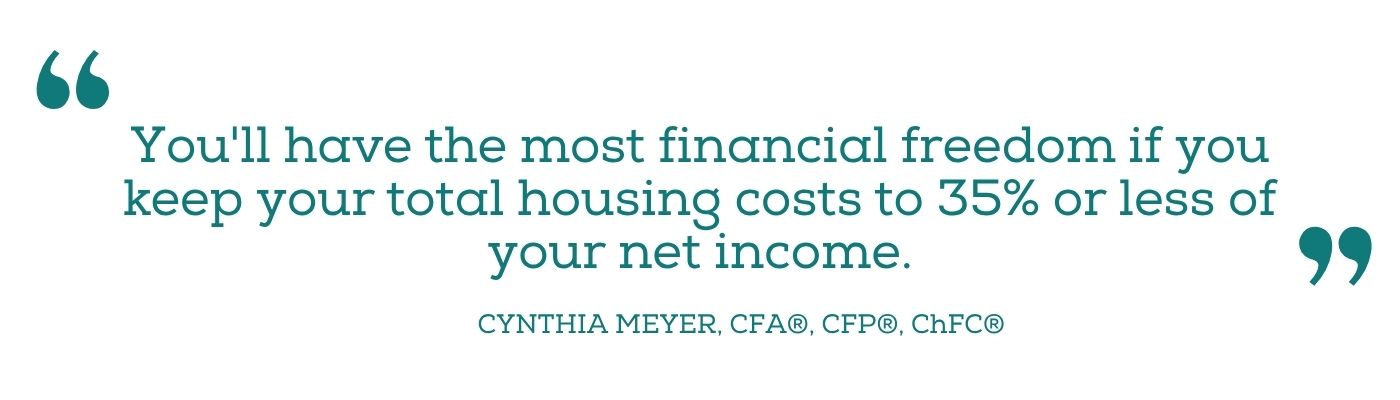
But first, it’s important to understand what actually goes into housing costs. A helpful guideline for people with a goal of becoming “work optional” or retiring early is to keep your total housing costs within 25-35% of your net income. That means your take-home pay — what’s actually available to spend — not just your gross income.
And importantly, this isn’t just your mortgage. Your true housing costs include:
- Mortgage
- Property taxes
- Homeowners insurance
- Utilities
- Ongoing maintenance
With all of these expenses accounted for, the numbers can look very different from those if you’re just calculating your mortgage costs. The purpose of this guideline (while relatively conservative) is to help you preserve your overall financial flexibility, even if you can technically qualify for a loan.
In higher-cost areas, it can be challenging to stay within that range, and not every situation will fit neatly into it, but it serves as a useful benchmark to understand the tradeoffs you may be making.
Why Do You Want to Upsize?
 Once you’ve looked at affordability, the next step is understanding why you want to make the move in the first place.
Upsizing isn’t inherently good or bad. Whether it makes sense for you depends on what you’re trying to accomplish.
For many homeowners, the motivation is needing more space. Maybe you have a growing family, or family members who will stay with you. Maybe you need a dedicated home office. Or maybe it’s more about lifestyle, and you’ve always dreamt about a larger home.
Sometimes homeowners move to lower-cost areas where more space is available for the same or lower cost.
All of these can be valid reasons; it’s just important to be clear about what’s driving the decision. Ultimately, your financial plan should reflect your life goals. A larger home may or may not support those goals.
Are You Ready for the Full Cost?
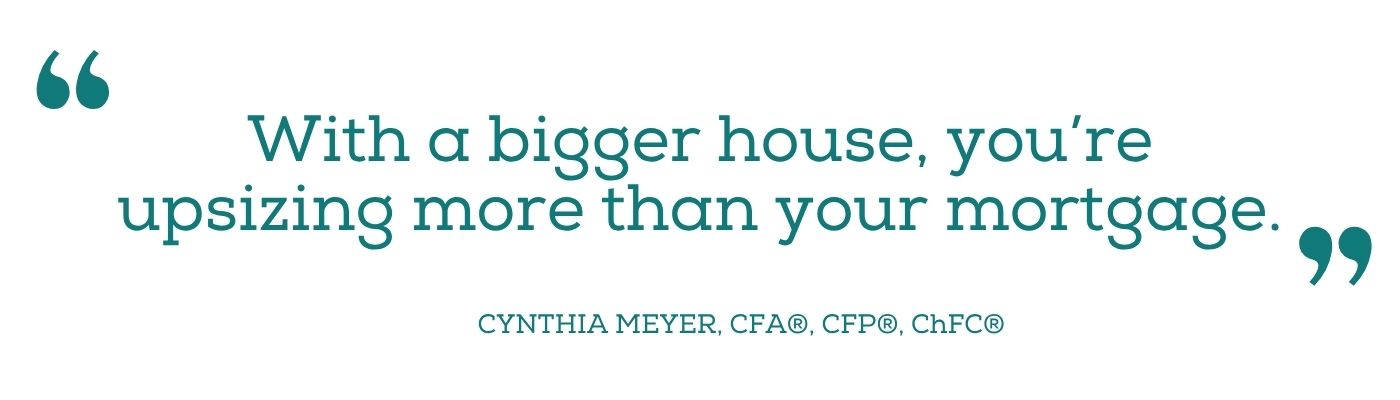
One of the biggest mistakes homeowners make when upsizing is focusing only on the mortgage. It’s easy to compare your current monthly payment to a potential new one and assume that’s the primary difference, but in reality, the cost of a larger home extends well beyond the loan itself.
As the size and value of a home increase, so do the associated expenses. That usually includes:
- Higher property taxes
- Increased homeowners insurance
- Higher utility costs
- Greater maintenance and repair costs
- Additional spending on furniture, landscaping, and upgrades
And these costs don’t just increase; they tend to scale with the home, sometimes proportionally and sometimes more than expected.
A helpful rule of thumb is that if your mortgage increases by 30%, your overall housing-related expenses are likely to rise around that same threshold.
You also have to consider lifestyle creep. Moving into a larger home can change expectations and lead to “keeping up with the Joneses”. Over time, these incremental lifestyle changes can add up.
Are You Ready to Spend More Time on Your Home?
 When my husband Steve was transferred from the Bermuda office of his firm to central NJ, we had the opportunity to upsize our square footage and bought a large home on nearly 3 acres. Our total housing costs were still going to be less than the supersized rent we paid for a small home in Bermuda, (a very expensive place to live.) Plus, thanks to the excellent area public schools, we would no longer have to pay for private schools, so we had some wiggle room.
We soon discovered that big houses take more time to maintain, both inside and out - not just more money:
- More rooms to clean
- More toilets to scrub
- More gardens to weed
- More lawns to mow
- Move leaves to rake
- More snow to shovel
Over the years, we’ve experimented with outsourcing deep cleaning, lawn care, and snow plowing. Ultimately, though, we are DIY people and we do most of it ourselves. If you’re considering upsizing, know that you’ll either have to spend more time - or more money - to live comfortably in your home.
 What Are the Tradeoffs?
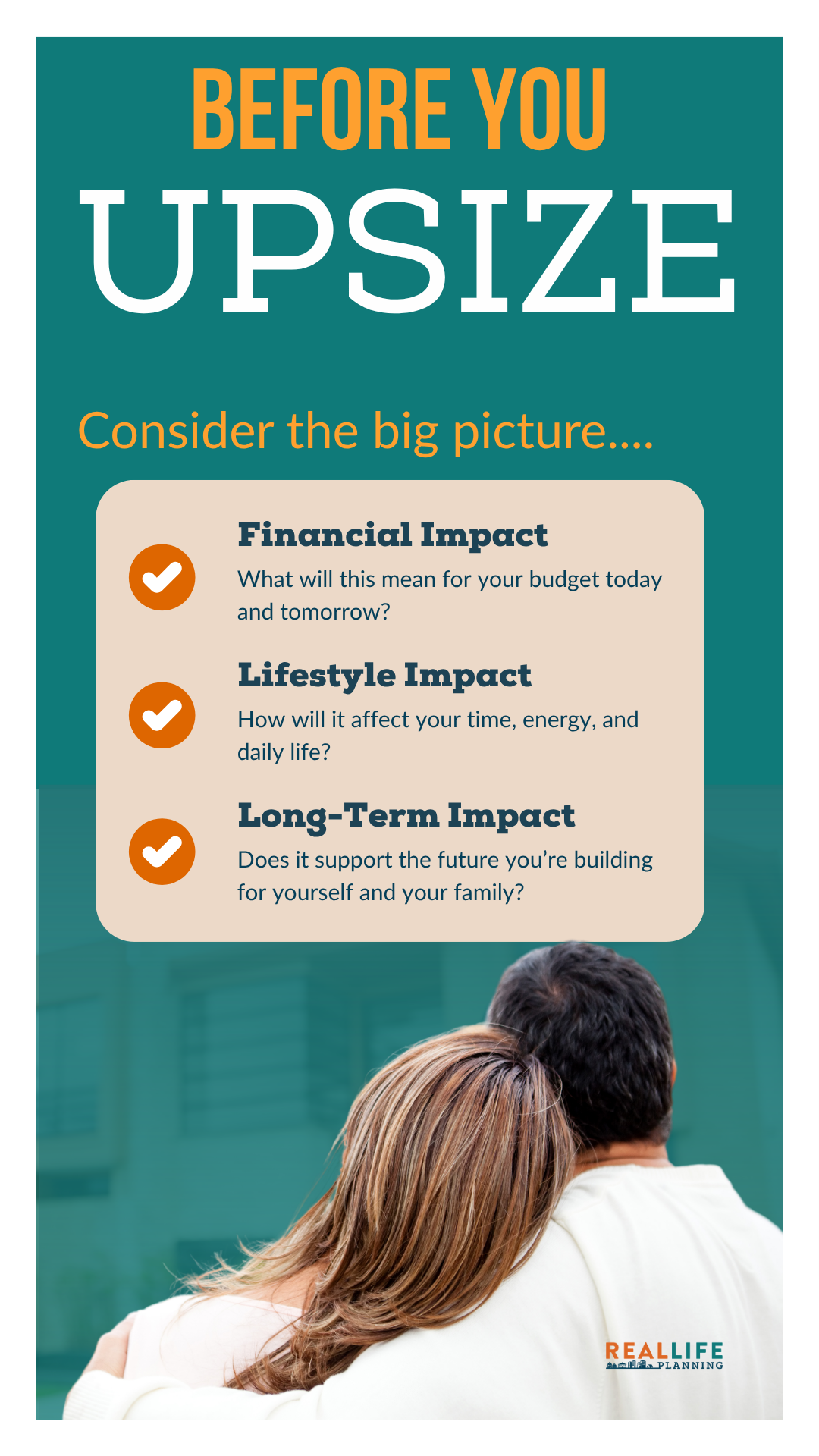
Part of evaluating moving into a larger home is thinking about what you may be giving up. A bigger home typically comes with a bigger financial commitment. Even if the numbers technically work, that added cost can change how the rest of your budget looks.
More money going toward housing can mean less available for other priorities — whether that’s travel, dining out, hobbies, or maintaining flexibility for day-to-day spending.
It can also affect longer-term decisions, like how aggressively you are able to save or invest. This isn’t necessarily a reason not to upsize, but it’s an important part of the decision.
You may want to ask yourself: do you want more house, or more freedom?
Does Upsizing Make Sense for You?
As you consider upsizing, the question isn’t just if you can afford a bigger home, but whether upsizing actually improves your situation.
There are scenarios where moving into a larger home can make a lot of sense.
If you can comfortably afford the full cost (not just the mortgage) and the move clearly supports your lifestyle, it may be the right decision for you. That could mean:
- Creating space for a growing family
- Accommodating extended family members
- Moving to a lower-cost area where more space is available for the same or less money.
In those cases, upsizing is intentional, tied to a specific goal, and supported by your financial situation.
But there are just as many situations where staying put may be the better option.
If your current home meets your needs, you enjoy your neighborhood, or your family isn’t on the same page on making a move, those are all valid reasons to pause.
The cost of selling and buying, combined with current market conditions — such as higher home prices or rising interest rates — can also make moving less attractive in the short term.
It’s also worth considering whether moving is the only way to solve the problem.
In some cases, reconfiguring your current space, adding an Accessory Dwelling Unit or a home office, or making targeted improvements can achieve the same outcome without the financial commitment of a larger home. Even for things like hosting guests, it may be more practical to use short-term solutions like nearby accommodations rather than upsizing specifically for that purpose.
Timing is another factor here. You don’t have to make the decision immediately. Market conditions, interest rates, and your own circumstances can develop over time. In many cases, waiting can make room for a clearer and more confident decision.
You’re Upsizing Everything, Not Just Square Footage
At the end of the day, upsizing is less about the house itself and more about how it fits into your overall life. Before you decide whether upsizing is right for you and your family, you’ll want to be clear on the full cost, why you want to make the move, and the potential tradeoffs.
Upsizing is a long-term commitment, and the right decision is the one that aligns with your finances, your lifestyle, and your priorities. A larger home absolutely has the potential to improve your quality of life, but only if it doesn’t create ongoing financial pressure or limit your flexibility in other areas.
If you’re weighing your options, it can be helpful to take a step back and look at the full picture. Review your budget, think through different scenarios, and talk through the decision with the right people, like a CERTIFIED FINANCIAL PLANNER™, before moving forward.