

20 Questions to Ask Before Investing in a Real Estate Syndication
Real Estate CoachingBy Cynthia Meyer, CFA®, CFP®, ChFC®
What you will get from this article:
| 🏠 | are real estate syndications a fit for inexperienced investors? |
| 🏠 | Understand the typical structure and roles in a syndication |
| 🏠 | identify the major risks of real estate syndications |
| 🏠 | know these important questions to ask a syndication sponsor when evaluating a deal |
Real estate syndications allow a group of accredited investors to pool their funds into a large real estate project. Syndications combine the financial resources of investors with the real estate expertise of the syndication sponsor. These deals offer the opportunity to reduce an individual’s risk; however, the success of the syndication depends heavily on the quality of its sponsor.
If you’re considering getting into real estate syndications, there are many things you want to know about the syndication sponsor and the deal before making any decisions.
That’s why we’re going to discuss real estate syndications and 20 questions that you should ask yourself before you make any final decisions.
 What is a Real Estate Syndication?
Real estate syndications allow investors to pool their resources to fund a real estate investment. These deals typically are used to fund larger projects (think: large apartment complexes, shopping malls, senior living centers, large student housing complexes, office buildings, etc.) They’re typically structured through a Limited Liability Corporation (LLC) or Limited Liability Partnership (LLP).
Can Anyone Invest in a Real Estate Syndication?
Real estate syndications are not for everyone. Syndications are for accredited investors only, meaning they’re for investors with a higher net worth, higher income, and a high level of financial sophistication.
The technical requirements to be considered an accredited investor and be provided offering documents for this type of investment are a net worth of $1 million or more — excluding your primary residence equity — and an income of at least $200,000 for single-filers ($300,000 for a married couple).
These are just the starting points for receiving and vetting these offering documents for yourself. Practically speaking, many of the participants in these types of projects are even wealthier and/or have higher incomes than just that starting point.
The bottom line: These are very financially sophisticated investments.
What are the Roles in a Real Estate Syndication?
A syndication is a hands-off investment, meaning that investors themselves do not actively participate in the day-to-day management of the project. The limited partners are passive investors only, providing capital in exchange for a potential share of profits.
The syndicator, otherwise known as the general partner or the syndication sponsor, manages the project from start to finish. They handle operations, financing, acquisition, reporting, and communication to investors.
The syndication sponsor manages the project, so they have all the votes in the day-to-day decisions, not the limited partners.
The three components of a typical real estate syndication deal are:
- Equity contributions: Investors supply funds for the initial costs of the project
- Debt financing: The property is financed with loans, like a construction loan or mortgage
- Profit-sharing: General partners and limited partners split the cash flow from the project and any potential proceeds from a future sale
What Are the Benefits of a Real Estate Syndication?
 Real estate syndications allow investors access to commercial real estate assets with much less capital than most average investors would have available. By pooling the capital from many investors, individual investors can invest in much larger projects.
These projects also allow for diversification into a non-correlated asset class. Commercial real estate often moves in a different direction, in certain economic conditions, than the stock market as a whole. This means that if the stock market is facing downturns, the diversification from the real estate assets can help diversify an investor’s overall investment portfolio.
Syndications are also a truly passive investment. The limited partners provide capital only and do not participate in the day-to-day operations of the project, making this a hands-off investment.
All of the professional management of the real estate project comes from the expertise of the syndication sponsor, as well as any parties that they hire to work on the project.
What are the Risks of a Real Estate Syndication?
While syndications come with their own set of benefits, they also have some major potential risks.
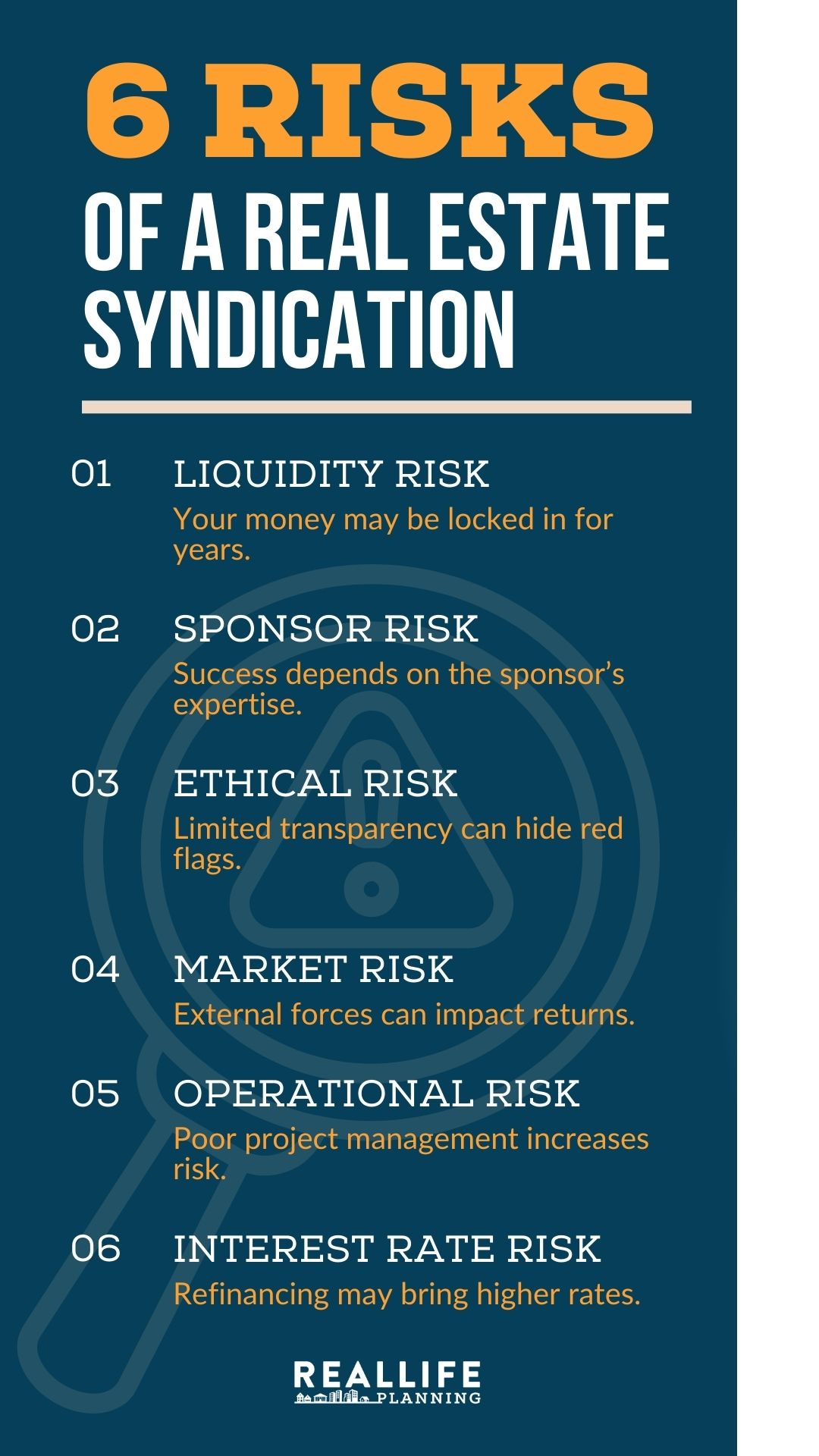 Liquidity Risk
As an alternative investment, real estate projects tend to be highly illiquid investments.
There is no public market for these investments, and an investor’s stake can’t be easily converted into cash under most circumstances, so your money may be locked up for the entire period of the syndication (typically 3-7 years).
Sponsor Risk
There is also a sponsor risk, or due diligence risk, as the success of the investment depends on the expertise of the syndication sponsor.
- Have they picked the right building? The right market conditions?
- Have they made the correct assumptions about financial assumptions about the property?
- Is the loan and the interest rate appropriate for the investment?
- Have they picked the right people to work on the project? (Contractors, architects, etc.)
- Is the project appropriately insured?
- Do they have good property management in place?
All of these operational and skill-based factors introduce some risk to the investors.
Ethical Risk
There is also an ethical risk with these projects. Because this is not a regulated area of investing, there isn't always complete transparency or clarity around the sponsor.
Maybe there’s a new sponsor or somebody who hasn't been tested or proven before. Or maybe someone isn’t an experienced investor, even though they might meet the qualifications of an accredited investor, and they don’t know all that their investment entails.
That’s why, when you're doing your due diligence, you really want to make sure you're making a good choice with a syndication sponsor.
Market Risk
There's also market risk, part of an investment that we can't control. We can't control what happens economically, politically, or geopolitically. This means there are risks in any project with the local, state, or national real estate market, as well as the broader economic and political environment.
Operational Risk
Investors also must be aware of operational risks in the day-to-day decisions. How the project is being managed, whether it's on time and on budget, and if those working on the project are actually the best fit.
Interest Rate Risk
Finally, there's interest rate risk. This is a big factor because commercial financing tends to reset or refinance every 5 years.
A project may start out with an initial fixed interest rate for 5 years, for example, and then resets 5 years later. This can cause problems if interest rates that were assumed to stay low end up being higher after that 5-year period.
Questions to Ask About a Syndication Sponsor
 Now that we've got an idea of what the basics of real estate syndications are and who should even consider looking into them in the first place, let's talk about some questions to ask if you are considering participating in a syndication.
1. What is their experience with similar deals?
This question will give you insight into the sponsor’s track record: how many successful projects they’ve completed, and if they have any references from past investors that you can potentially reach out to.
2. What was their performance on previous projects?
Syndication sponsors whose primary role is managing commercial real estate projects likely have been compiling metrics that you should be able to review. This includes things like past projects’ return on investment (ROI), internal rate of return (IRR) on equity, timeframes, and risk mitigation; all of which should be transparent and clearly disclosed.
3. What is the investment strategy?
This should give you information about the investment and how the sponsor plans to pursue the deal. This includes things like what type of property you’ll be investing in (and why), and the rationale for this particular property at this time, in this market environment, in this economy.
There should be some market analysis or rationale for this property selection, including a breakdown of any unique factors about the property or its location that would make this a good investment.
4. What is the business plan for the real estate project?
Like any other business investment, a real estate business should have a plan for any value-add strategies or exit strategies to plan for how you’ll realize the value of this investment at the end of the syndication period.
5. What is the target rate of return, and how is it calculated?
You’ll want to go into this deal understanding things like expected cash flow, internal rate of return, and equity multiples so that you can compare this deal to others and decide on your best investment.
6. What is the deal structure?
Before you invest in a syndication, you’ll want to be clear on the deal’s structure. What are their projected timelines for distributions to investors and for an exit strategy? When and how will profits be returned to investors, assuming there are profits?
There should be a projected timeline for this. While things may not happen exactly as planned, there should be a plan in place for how cash flow will be returned to investors.
This is very deal-dependent. For a built-to-rent situation, this could be years, whereas if you're buying an asset that already has tenants in it, it could be within a couple of months.
7. How are profits shared between general partners and limited partners?
There should be a clear explanation of the profit-sharing structure and how cash flow and profits will be split between limited partners and general partners at different stages of the project.
Generally, the split will change over time as the internal rate of return gets higher over the course of the project, so you want to have clear expectations going into the project.
8. What are the biggest risks in the project, and how are they mitigated?
This is an area where a newer reviewer of syndication offering documents may not pay enough attention, but it’s incredibly important. These include those market risks, interest rate risks, vacancy risks, and all the operational challenges that we’ve discussed before.
Some of those risks can be transferred or mitigated with insurance, and some of them can't. You want a clear list of risks and how the syndication sponsor views those risks.
An important note: If you are an accredited investor reviewing these documents, if risks aren't listed or aren't included, that's generally a very bad sign.
9. How are fees structured?
As part of the deal structure, there are fees beyond the share of cash flow and sale proceeds between general unlimited partners. Typically, the syndication sponsor will also earn fees from other parts of the project. That could be funding fees to raise money from investors, acquisition fees, property management fees, disposition fees, etc.
You want to make sure that you're clear on all of these fees as you read through these offering documents, so that you’re aware of what the total fees are and how that's going to affect your net cash flow.
10. What are the investor updates that you can expect?
Before you work with a sponsor, you want to know how they will communicate with limited partners and how often updates will be provided. Is there an investor portal? Will you receive monthly or quarterly updates? How transparent will that communication be?
Generally, the more seasoned a sponsor is, the more formal the process they may have for investor communications.
11. Can you exit early?
If, down the line, you decide to exit the project, you want to have made sure beforehand that this is an option. You also want to understand what’s required to be able to do so, and if there are any options for liquidity or resale.
Often, there is no option for liquidity in these deals, so you want to be aware of that before making an investment decision.

12. What are the operational and legal considerations of the project?
As a hands-off investor, you want to be clear on the roles of the hands-on participants in the deal, so that you know the roles and responsibilities of all parties involved. Knowing what the operation-side parties are responsible for, as well as understanding your legal considerations and real estate syndication laws, is a key part of evaluating any deal.
13. How is the hands-on team going to be managing things on a day-to-day basis?
Part of understanding the day-to-day operations is to get an understanding of the team. You’ll want to know who will manage the property daily, and what their team's experience and/or property management qualifications are.
14. What happens if the project underperforms?
This is critical for you to be aware of as an investor for this type of project, because you want to be prepared for all possible scenarios.
Maybe there’s a capital call where investors may be expected to contribute more capital to the project, or maybe there’s a polling process for investors to decide if they want to sell the property at a loss or put more capital in.
You want to be prepared for any of these scenarios before investing in a real estate syndication.
15. Are there any contingency plans in place for delays and financial shortfalls?
Just like any other business, you want to be aware of how different potential scenarios could affect your investment, and how prepared the team is for these scenarios. It’s helpful to know if they have emergency cash reserves, if they have appropriate insurance, etc.
16. What's the legal structure of the syndication?
This will help you understand your rights and liabilities as an investor, along with any potential tax implications for the project. These are things you’ll likely want to consider with your attorney and/or tax advisor with experience in real estate syndication laws.
17. Is the syndication sponsor personally investing in the deal?
Does the sponsor real estate syndication company have skin in the game for the syndication? Is their own money on the line? You want to go into the deal confident that the sponsor shares the interests of their limited partner investors.
18. Is there a way to work with a 1031 exchange?
If you’re in the midst of a 1031 exchange or would like to fund participation with funds from a 1031 exchange, the structure of a typical syndication would not allow for taking funds from this exchange.
However, if it's a small syndication project, and you’re in the middle of a large 1031 exchange, you may be able to work something out with the sponsor. It may be worth having a conversation with the sponsor to see if they are able to structure the deal to make it work.
This is not a very common occurrence, but if it's something that's important to you, you want to start asking questions about it up front.
19. How can you avoid scams in syndication investments?
As a practice, you want to be on the lookout for marketing pitches that are overly salesy. This isn’t to say that a polished presentation, brochure, or webinar about the deal is uncommon from a sponsor, but these should be backed up by disclosures and legal language in the offering documents.
If materials are representative of all of the benefits and none of the risks of the property, this generally isn’t a good sign.
Since this area of investing isn’t regulated the same way as other investments, it’s crucial to vet your sponsor and do your due diligence before taking on an investment. This won’t protect you from all risk, but it can help you weed out some of the bad actors in the space.
20. How can you learn more if you're interested in getting involved in this type of investment?
Having access to more information is a great tool when it comes to making investment decisions.
One way to learn more is to work with a financial advisor who has lots of experience with alternative investments and can help vet them for you. There are plenty of registered investment advisors that specialize in alternative investments who have the right expertise to help you with these questions.
If you're more of a DIY investor, you can get smarter about all things private real estate.
BiggerPockets has a new service called PassivePockets, where they are building a portal for soliciting reviews of syndication sponsors from other investors who've participated in deals.
The goal is to build a system for organizing information and offer some initial due diligence on the process to accredited investors. While they're just getting it off the ground, it’s definitely something worth looking into.
Another thing you can do is just sign up for some of these crowdfunding portals that offer syndications — assuming you're an accredited investor — and take a look at some deals. You can go to webinars, download their brochures, and read the offering documents. You can even take this list of questions (and all the other types of questions that you can think of yourself) and start reading through these documents.
By the time you're ready to consider doing this for yourself, you should be able to understand what you're looking at, what you're reading, and what questions you're going to ask the syndication sponsor so that you can help make better decisions.
Final Thoughts
Now that we’ve covered key information and details that you should ask yourself about real estate syndications and sponsors, you should be armed with the information you need to learn more about these deals.
As always, make sure you talk to your attorney, your accountant, your financial advisor, or a specialized real estate financial planner before making these decisions. Participating in real estate study groups where you can learn more about these types of larger commercial real estate projects can also teach you more about these alternative investments.
The more you know, the better an investor you will become, so try to put education first before you ever sign anything.
If you want to learn more about real estate investing, be sure to check out The Real Life Blog, or you can schedule a call with our team to work with a specialized real estate financial planner with deep experience in the industry.
🏠 If you have a topic you'd like us to tackle on The Real Life Blog, we would love to hear from you! Please email us at info@realifeplanning.com.
This blog is for general financial education purposes. Information contained in this blog should not be construed as financial, tax, real estate, legal, or investment advice. For educational purposes, blog posts may contain links to other websites which are not under the control or and are not maintained by Real Life Planning. Real Life Planning has provided those links for your convenience but does not necessarily endorse all the material on those sites. Please consult your financial, real estate, legal, or tax advisor for advice specific to your situation.