

What is in a Real Estate Contingency Plan?
Real Estate CoachingBy Cynthia Meyer, CFA®, CFP®, ChFC®
What you will get from this article:
| 🏠 | What a real estate contingency plan is and why it matters for investors |
| 🏠 | Key elements to include so your business can run without you |
| 🏠 | How to choose and prepare someone to step in during an emergency |
| 🏠 | Tools and workflows to streamline operations and documentation |
| 🏠 | Why sharing this plan with your spouse or trusted contact is essential |
What happens to your rental properties if something happens to you?
What would happen if you were ill or in the hospital? Or, if you’ve had an accident? What would happen if you were incapacitated or injured in some way, or if something happened in your family that would require your full time and attention?
What would happen to the day-to-day operations of the rental property business you’ve built?
Luckily, this is something that we can prepare for with something called a contingency plan. For new and seasoned investors alike, the real estate contingency is a key strategy for risk management and ensuring due diligence.
Whether you have one property or 50, contingency plans are important for all real estate investors to know about.
What is a Contingency Plan in Real Estate?
A contingency plan is a written plan or system that ensures that the rental property business can continue to operate if the owner(s) are temporarily or permanently incapacitated and unable to operate the business.
What are the Elements of a Real Estate Contingency Plan?
One important part of a real estate contingency plan is that it’s written. It doesn’t have to be anything fancy, but it does have to be written down and shareable with the person who will take over if you are injured, incapacitated, or otherwise unavailable.
 Having this in writing could be as simple as a piece of paper that you share with one of your children, a Google Doc, a workflow in project management software such as Asana, a third-party digital estate planning system (like Everplans® for example), etc.
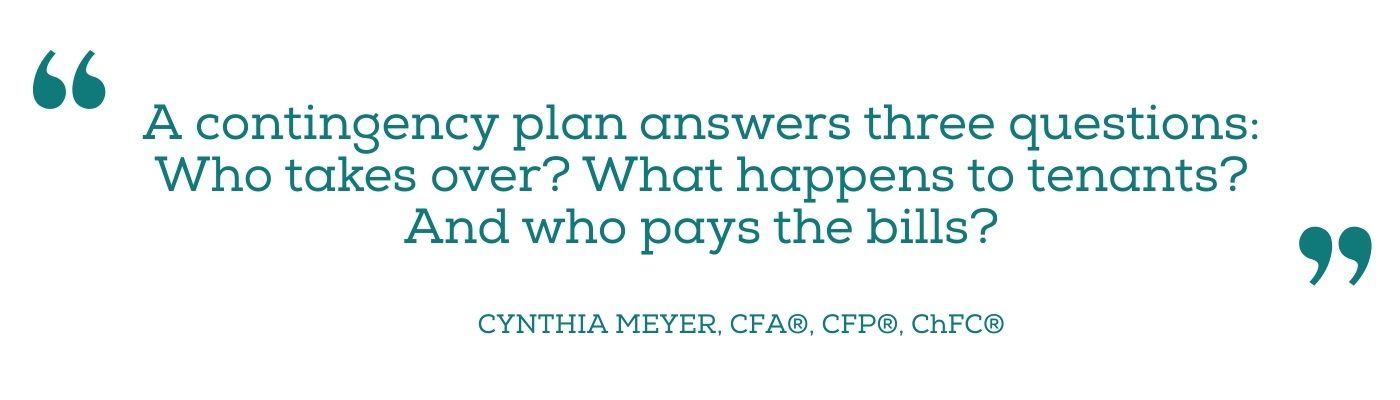
The contingency plan must address these questions:
- Who takes over the operations of the real estate business?
- What happens to tenants and tenant communication?
- Who pays the bills?
There are operational and financial components that must be addressed in a contingency plan to prepare your business in the event that you cannot run it yourself.
What Triggers a Contingency Plan?
A contingency plan can be implemented with different triggers, such as a medical incapacity like an injury or accident, a military deployment, etc. Anything that would require someone else to step in or you to step away from your business for an extended period of time could be a good contingency plan trigger to implement.
Why Do You Need a Contingency Plan for a Real Estate Business?
Real estate is an ongoing business. While rental income is treated as passive income on a tax return, rental properties are not passive in terms of effort. Somebody must be able to deal with tenant issues and maintenance problems on a day-to-day basis. If the tenants don’t have somebody they can reach for maintenance or emergencies, it could escalate into a much bigger issue.
In addition to running the daily operations, bills still need to be paid. The mortgage, property taxes, insurance, etc, all need to be paid. 
If you were in a situation where your bills were unpaid for an extended period of time, and there was no way for your children, for example, to access those accounts and pay the bills, you could default on your mortgage. The property could also lose some value or income due to neglect in your absence.
Succession Planning for Your Real Estate Business
Another reason that contingency plans are so important is that they help you be very intentional about the kind of real estate business you want to leave your spouse and/or children.
Part of succession planning is making it easier for your family to take over in the event that you are incapacitated. You don’t want to leave a mess for your children to clean up; you want to leave a clearly run and structured business with workflows, processes, documentation, and a list of where everything is.
How to Build a Real Estate Contingency Plan
The first step to building a contingency plan for your rental property or real estate business is to designate somebody to take over if you’re injured, incapacitated, out of the country, or otherwise unable to run the business for an extended period of time.
You want to have a primary and secondary designation for who will make decisions for your business if you can’t. Typically, this involves a durable power of attorney as part of your real estate planning process. If you own your properties in a living trust, your trust may have provisions for this, but it’s still something you want to think about as part of the planning process.
You also want to have a process for sharing important information. Even if you don’t give somebody power of attorney, you still have to decide who will know where everything is and how things get paid. This may be a property manager or one of your children, for example.
If you don’t have children who could take over, you may want to think about a trusted friend or colleague who could take over for you until you are no longer unable to run the business, if applicable.
 What to Document in a Contingency Plan
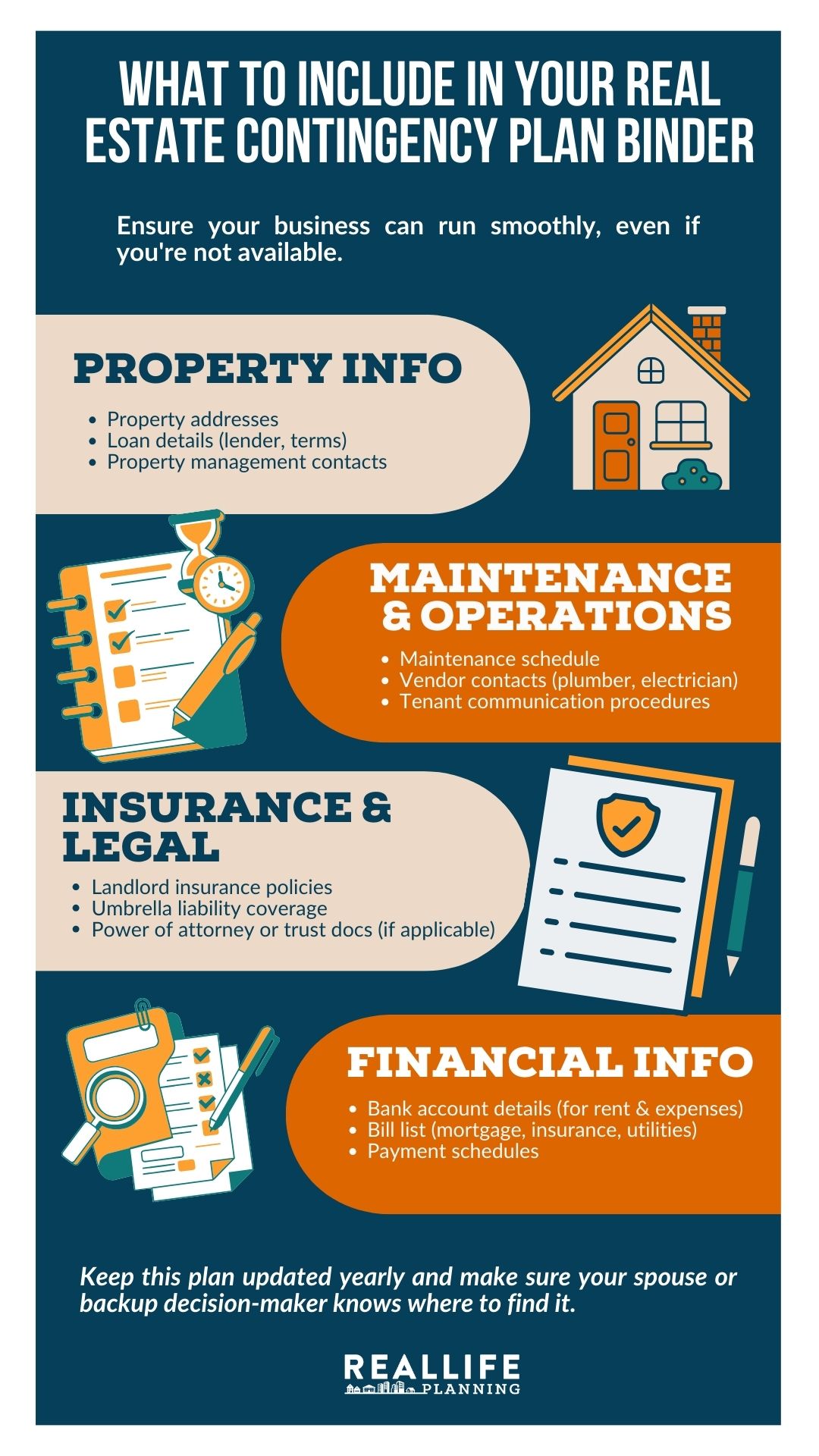
The next step of the contingency plan is to document everything very clearly, whether in a physical binder or a digital vault. You want to include things like the address of each property, the loan information, the bank information, and all of the regular bills that are in your name.
A schedule of regular activities or maintenance may also be helpful to clearly document here. You also want to include insurance policies, like the landlord policies for the property or umbrella liability insurance.
In essence, if somebody was to look through your documentation, they should be able to pick up and carry on operations with minimal hassle.
Who Will Communicate with Tenants?
It’s also important to plan for who your tenants can communicate with. In fact, you may even want to have a backup contact for your lease.
If you have a professional property manager — who you also want to make sure has a contingency plan for their property management business — they will likely be the point of contact for your tenants.
However, if you are managing the property yourself, you want to let your tenants know about any backup contacts they can reach if they can’t get in contact with you.
What Can You Automate?
Establishing digital processes for your business for things like bookkeeping, collecting rent, paying bills, and tracking expenses and maintenance issues can help you keep things more efficient and reduce the amount of responsibility that needs to be manually handled in your contingency plan.
There are many ways to do this. You could work with a real estate bookkeeper, for example, or look into software like Stessa, Buildium, AppFolio, RentRedi, or Tenant Turner for property management.
Create Rental Property Workflows
Creating workflows (processes for how certain things are done) can also help you automate or streamline parts of your business. For example, if you’re managing properties yourself:
- What is your tenant screening process?
- Where do you advertise your properties?
- Who do you use to check credit?
- What system are you using for generating compliant leases?
- Where do you keep your security deposits?
- What’s the process for when a tenant moves out?
- When does the property get inspected?
- How do you decide whether to deduct from the security deposit or not before you refund?
Everything that you do in that day-to-day business management should be written down in a workflow. You can use software like Asana or Trello, for example, to map out these workflows. You can also just make a list in a Google Sheet or something similar. Even just writing these in a notebook is better than having no documented processes in your contingency plan.
You also want to do this for things like utilities, for example. When the tenant moves out, how do you get the utilities put back in the name of the landlord?
Many plans have workflows for maintenance, so when a tenant requests something, you know who to call and how to document. You may also want to create workflows for financial tasks like paying bills.
Who Else Needs to Know if Something Happens to You?
 The final part of a contingency plan is to decide what other professionals need to be involved if something happens to you. Whoever your trusted person is, they should know who your accountant is, your real estate financial planner, your insurance agent, etc. They should be able to contact whoever they need to for your business.
If you are working on your broader contingency plan, I encourage you to check out the checklist that we have created to help you keep track of the basic elements of a contingency plan that we’ve gone over.
What is a Real Property Emergency Packet?
Another part of contingency planning, separate from the binder or digital vault that you create, is a rental property emergency packet. This has things for your trusted decision-maker, like:
- A list of all the properties
- Who the tenants are
- A snapshot of the cash flow
- Logins for key accounts
- A list of who to call (like the property manager, attorney, CPA, handy person, etc.)
Do Both Spouses Know Where Everything Is for Your Business?
As a real estate financial planner, something that I've seen a lot over time is that only one spouse in the relationship takes care of all the bills, or only one spouse takes care of the real estate business.
The other spouse, in these scenarios, often doesn't know where everything is or what the systems, processes, and important people are in case of an emergency. It's important that, if you’re married, your spouse knows what these things are, even if they're not helping you manage the day-to-day business of the real estate.
So, not only should your trusted person know these things if something were to happen to both of you, but you want to make sure that both spouses know how to access these things in case of an emergency.

Bottom Line
Like with all businesses, you want to have a plan in place ahead of time that could help your business run smoothly with minimal hassle in the event that you cannot run the operations yourself.
This part of the financial planning process is often the most difficult for people to tackle, having to face the possibility of being injured or incapacitated, but it’s important not to put this off. Once it’s done, a contingency plan can give you peace of mind, knowing that processes and documentation are in place to protect your business if something happens to you.
I encourage you to check out our contingency planning checklist and create a contingency plan as a gift to your family and/or trusted individuals (that I hope you don’t have to use for a long time). If you want to learn more about contingency planning for your business, we encourage you to schedule a call with our team of CERTIFIED FINANCIAL PLANNER™s.
🏠 If you have a topic you'd like us to tackle on The Real Life Blog, we would love to hear from you! Please email us at info@realifeplanning.com.
This blog is for general financial education purposes. Information contained in this blog should not be construed as financial, tax, real estate, legal or investment advice. For educational purposes, blog posts may contain links to other websites which are not under the control or and are not maintained by Real Life Planning. Real Life Planning has provided those links for your convenience but does not necessarily endorse all the material on those sites. Please consult your financial, real estate, legal, or tax advisor for advice specific to your situation.