

What to Know Before Buying Real Estate in a Retirement Account
Financial PlanningBy Cynthia Meyer, CFA®, CFP®, ChFC®
This article is for educational purposes only and is NOT tax advice. See a professional tax advisor, such as a CPA or EA for personalized tax guidance.
What you will get from this article:
Can you put rental properties into your IRA?
As a real estate financial planner, I hear this question all the time from real estate investors curious about how retirement accounts can hold property. It’s a great question, and it all comes down to understanding self-directed retirement accounts: what they are, what’s allowed, what’s not allowed, and when it might (or might not) make sense to use one for real estate investing.
There’s a lot of chatter online about real estate inside IRAs, especially in investor forums, but the IRS rules are clear. Understanding them before you act can save you serious time and money.
It’s important to note: This discussion is for educational purposes only. This is not tax or investment advice. Before you make any moves, talk with your CPA or financial planner. For reference, much of this guidance comes directly from IRS Publications 590-A and 590-B.
What Is a Self-Directed IRA?
A self-directed IRA is a retirement account that allows you to invest in nontraditional, non-publicly traded assets — things beyond the typical mutual funds, stocks, or bonds.
You’re still the account owner, but instead of being limited to the usual investment menu, you have the freedom to choose from a wider range of options. Most investors already “direct” their IRAs by picking their own funds or securities, but a self-directed account goes further.
It can hold real estate, such as single-family or multifamily properties, commercial buildings, or even land. It can also invest in private LLCs or partnerships that own real estate, or in notes and mortgages you’ve lent to other people. Some investors even hold other types of income-producing assets, provided they’re allowed under IRS rules.
There are limits, though. You can’t use your IRA to buy or live in your own home, or for any personal property that benefits you or your family directly. These accounts are meant for investment use only.
Can other account types be self-directed?
Yes. Self-directed retirement accounts can take several forms:
- Traditional or Roth IRAs
- Solo 401(k)s for self-employed investors
- SEP or SIMPLE IRAs for small businesses
- Even Health Savings Accounts (HSAs), though that’s less common
What You Can and Cannot Own in a Self-Directed Retirement Account
 When it comes to a self-directed retirement account, the IRS actually makes it very clear what’s allowed (and what’s not) under IRC §408 and IRS Publication 590-A.
Let’s start with what you can invest in.
Allowed Investments:
You can use a self-directed IRA to buy real estate and other nontraditional assets, as long as they’re used strictly for investment purposes. That includes:
- Residential or commercial rental property (like single-family homes, apartment buildings, or retail space)
- Raw or undeveloped land
- Private notes and mortgages you lend to other people
- Ownership shares in LLCs or partnerships that hold property
- Certain offshore real estate or income-producing assets, as long as the transactions are properly structured
But the IRS also draws clear lines around what you cannot own in a self-directed IRA, as listed in IRC §408(m).
Prohibited Investments:
- Collectibles like art, antiques, metals, gemstones, stamps, or coins
- Alcoholic beverages
- Life insurance contracts
- Shares of an S corporation, which are off-limits to IRAs under tax law
Beyond the list of assets, there are also rules about how you use them. The IRS prohibits what’s called self-dealing. This means you cannot buy, sell, rent, or personally benefit from any property held inside your IRA.
That also means no transactions with disqualified persons, including:
- You or your spouse
- Your parents or grandparents
- Your children, grandchildren, and their spouses
For example, you can’t buy your own home in your IRA or rent it to yourself. You can’t borrow money from your son-in-law to finance an IRA property. And you can’t give repair work to your brother-in-law’s contracting company.
Simply put: your IRA is a tax-advantaged investment account, not an extension of your personal real estate business.
Contribution Limits and Account Types for Self-Directed Retirement Accounts
Self-directed accounts can take several forms: from a standard Traditional or Roth IRA to a Solo 401(k) or small business plan. Each comes with its own contribution limits and flexibility.
For Traditional and Roth IRAs, you can contribute up to $7,000 per year for 2025, or $8,000 for 2025 if you’re age 50 or older. For 2026, limits increase to $7,500 or $8,600 for 50+. These limits apply across all IRAs you own (you can learn more about them in IRS Publication 590-A).
Roth IRAs also have income limits that may restrict direct contributions, though some investors use a backdoor Roth strategy — contributing to a Traditional IRA and then converting it to a Roth.
If you’re self-employed or run a small business, plans like a Solo 401(k), SEP IRA, or SIMPLE IRA can allow much higher contribution limits, sometimes tens of thousands of dollars annually, depending on your income and business structure. These are detailed in IRS Publication 560, which covers small business retirement plans.
The Power of a Solo Roth 401k for Real Estate Investors
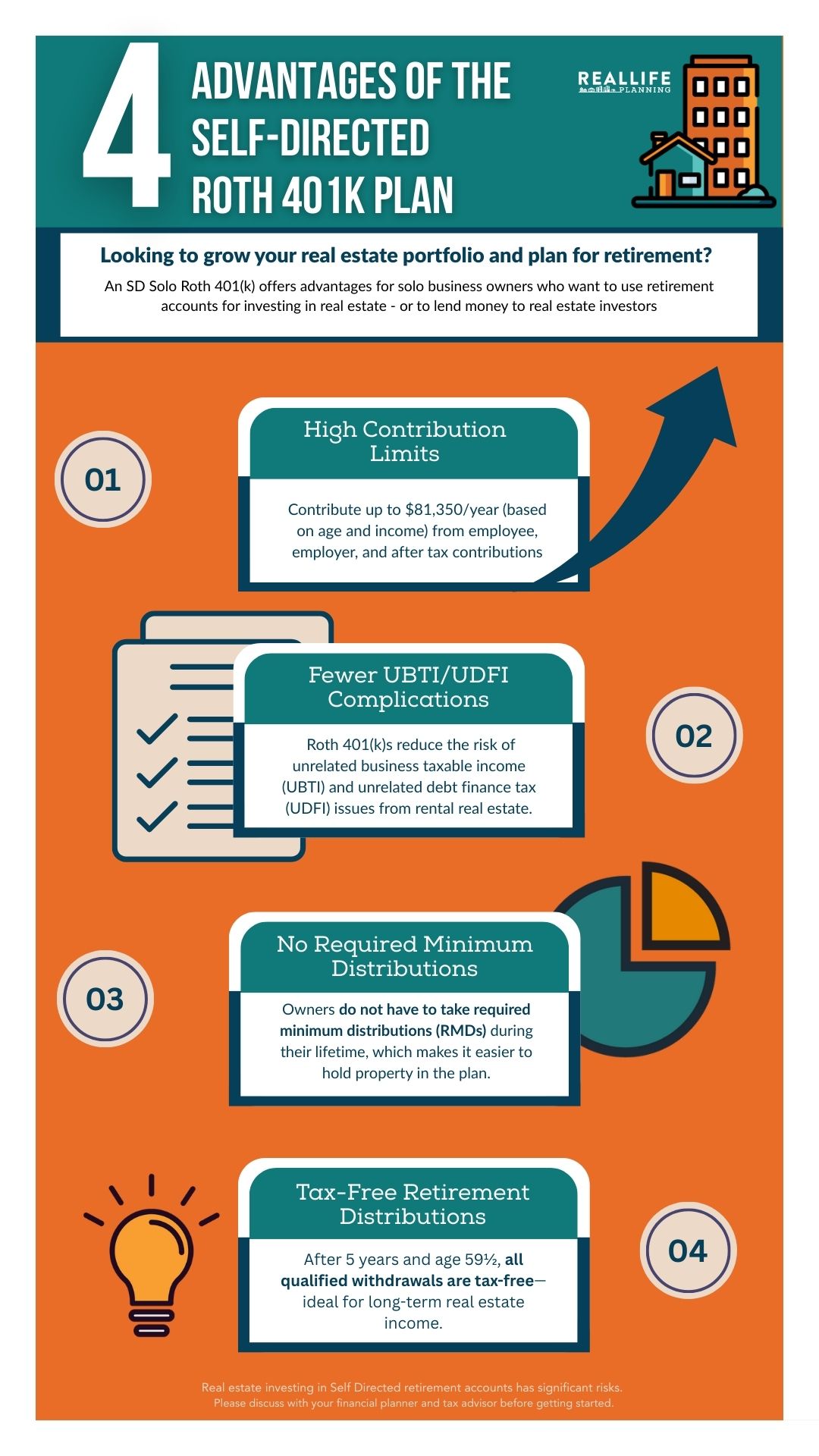 As a financial planner for real estate investors, I find that the tax benefits of owning real estate directly are valuable. However, for real estate investors seeking to own real estate in a retirement account, I find that Solo Roth 401(k)s offer the most flexible and powerful structure. Solo Roth 401k offers business owners:
- High annual contribution limits. A business owner may be able to contribute up to $72,000 (or $80,000 if 50 or older or $81,350 if 60-63) as Roth/Mega Backdoor Roth Solo 401k contributions (depends on total business income).
- Tax free distributions for distributions after 5 years/age 59 ½.
- Higher limits offer more flexibility and investment choice
- Fewer complications with unrelated business taxable income (UBTI)
That extra room to contribute, and the ability to direct those funds into real estate or private deals, can make the Solo Roth 401(k) an especially attractive option for real estate investors.
How Real Estate Is Purchased in a Self-Directed Retirement Accounts
If you decide to buy real estate inside a self-directed retirement account, there are two main ways to do it: through a direct purchase or a partnership structure. Each comes with its own set of rules and restrictions under IRS Publication 590-A and IRC §4975(c).
Direct Purchase
The simplest approach is to buy a property directly using funds from your IRA. If your account has a large enough balance, you can buy the property outright for cash. In other cases, investors use a non-recourse loan, which means that only the property itself serves as collateral.
It’s very important to note: you cannot personally guarantee the loan. That would be considered a prohibited transaction because you can’t pledge personal credit or assets for something owned by your IRA.
Partnership Structure
Another option is to buy a property in partnership with another entity, such as your spouse’s IRA, another investor’s IRA, or even personal funds. In that case, ownership shares are divided proportionally to each partner’s contribution.
Regardless of how you buy, all income and expenses must flow through the IRA itself, never your personal bank account. You also can’t “sweat equity” your way into extra value: you’re prohibited from performing any labor on the property, including repairs or renovations. All work must be done by independent contractors to stay compliant with IRS rules on self-dealing.
It can be quite a powerful strategy, but one that requires strict separation between your personal and retirement finances.
The Hidden Costs and Administrative Burden of Self-Directed Retirement Accounts
One of the biggest surprises for investors exploring self-directed retirement accounts is the cost of maintaining them. When you invest in low-fee index funds, you can often open and manage the account for free, or very close to it. But with real estate inside an SD-IRA or SD-401k, the costs add up quickly.
Typical custodial and reporting fees can range from 1% to 3% of the account’s value each year, depending on how complex the account is. Those fees can increase based on:
- The number of assets held in the account
- How often those assets need to be valued or appraised
- The complexity of transactions or partnerships involved
Because real estate must be valued annually, you’ll often need to pay for an independent appraisal to determine the property’s fair market value for IRS reporting. Add in custodial fees, legal compliance, and potential state-level requirements, and the administrative load can become substantial.
RMDs and the Challenge of Owning Property in Retirement Accounts When You’re Older
 As investors reach the Required Minimum Distribution (RMD) age, currently 73 (75 for taxpayers born in 1960 or later) under the SECURE 2.0 Act, real estate inside a retirement account can become tricky to manage.
With liquid investments like stocks or mutual funds, taking your annual RMD is simple: you sell a portion of your holdings and withdraw the required amount. But you can’t sell part of a building to meet an RMD requirement.
You could update the property deed annually to reflect in kind distributions of partial ownership, but that’s cumbersome, requires a new appraisal, and can be expensive..
That means you’ll need to maintain enough liquidity inside the IRA (cash, bonds, or other assets) to cover the withdrawals each year. Even if the property is generating net rents, there is always the risk of vacancy or nonpayment.
Some strategies to manage this include:
- Holding a mix of liquid assets alongside the real estate to fund RMDs
- Partially converting to a Roth IRA, which can reduce or eliminate future RMDs
- Planning ahead with your financial advisor to ensure you won’t be forced into an untimely property sale
This is one reason I often emphasize the flexibility of Roth IRAs and Roth Solo 401(k)s. Roth accounts have no RMDs and allow tax-free withdrawals in retirement, making them far easier to manage if you want to hold long-term assets like real estate.
Why Some Investors Avoid Real Estate in IRAs
 Just because you can hold real estate in a retirement account doesn’t always mean you should.
When you own investment property directly, you get to enjoy the marvelous tax advantages of real estate ownership. You can deduct depreciation each year, which helps shelter a portion of your rental income from taxes. You can also use 1031 exchanges to defer capital gains taxes when you sell one property and reinvest in another.
Inside a retirement account, you give up both of those benefits.
There’s no depreciation deduction available to offset income, and 1031 exchanges aren’t permitted within IRAs or 401(k)s. While it’s true that investments in a traditional IRA grow tax-deferred, real estate already has built-in tax efficiencies that make direct ownership far more flexible.
And when you eventually withdraw money from a traditional IRA, every dollar is taxed as ordinary income, not as capital gains. That means you could end up paying more in taxes later than you might have as a direct property owner.
So it’s not that you can’t do it — it’s that you should carefully weigh whether you should. For many investors, the numbers simply work better when the real estate is held outside of a retirement account.
Final Thoughts
Yes, you can hold real estate in a retirement account, but the IRS rules are strict. There’s no self-dealing, no personal use, and no transactions with family members. Every dollar of income and every expense must flow through the account itself.
The costs and complexities can be significant, from custodial fees to compliance requirements. For many investors, owning real estate directly, outside of a retirement account, offers more flexibility, control, and tax advantages.
Before making any decisions, I urge you to talk with a real estate financial planner or CPA familiar with the IRS restrictions. Consider whether a Roth IRA or Solo Roth 401(k) might give you the flexibility you need without the headaches of managing property inside a traditional IRA.
Ultimately, it’s about strategic asset location; deciding what belongs in your IRA and what’s better held personally to maximize your financial freedom.
If you’re considering whether holding real estate in an IRA is the right strategy for you, we invite you to book a call with our team to see how we may be able to help you. For more real estate investing insights, check out the Real Life Blog.