

10 Real Estate Questions to Ask Your Financial Advisor
Financial PlanningBy Cynthia Meyer, CFA®, CFP®, ChFC®
What you will get from this article:
| 🏠 | How to determine if your financial planner has real estate expertise? |
| 🏠 | how can your financial planner help you with real estate decisions? |
| 🏠 | can your financial planner help you identify and manage risks in your real estate business? |
| 🏠 | what real estate planning and analysis tools does your advisor use? |
Do you have open discussions with your financial advisor about real estate?
Recently, while at a conference teaching other financial planners about advanced 1031 exchanges, I realized that, though there were many great financial planners in the room, many of them told me that their clients did not ask them about real estate.
These were fiduciary financial planners who were members of NAPFA (National Association of Personal Financial Advisors), all fee-only, and all interested in real estate. This got me thinking about what some good questions would be for real estate investors to ask their financial advisors to open that conversation about real estate.
That’s why we’re going to share 10 real estate questions for you to ask your financial advisor that they should be prepared to answer (and, if they can’t, they can hopefully refer you to someone who can).
Question #1: What types of properties and other real estate investments are currently in your portfolio?
This question will help you understand your advisor’s attitude about real estate as an asset class.
Do they own rentals or rent out their house on Airbnb? Do they own a vacation property? Have they lent money in the real estate space to somebody else? Are they invested in a syndication or a private lending fund?
They may even be investing in less common ways, like buying tax liens or being a hard money lender. Maybe they’re incorporating real estate in a self-directed retirement account.
If you have a real estate business and own real estate as part of your investment portfolio, it’s important to have a holistic view of your personal finances. It’s helpful to know what your financial advisor or financial planner can help you with in that area. Since real estate is part of your total net worth, you’ll want to make sure your advisor knows about it.

Question #2: How does your financial planning software handle my real estate holdings?
Why am I encouraging you to peek under the hood at how the financial planning software works behind the scenes?
There are different types of software programs that work very well for modeling the risks and rewards of real estate in someone’s financial plan, and there are others that don’t do that very well.
 The software subscription that we use at Real Life Planning is called RightCapital. It’s a very robust, real-estate-friendly software that can model lots of “what if” scenarios, including 1031 exchanges, cash-out refinancing, a flip, and lots of other things.
eMoney is another very robust software for real estate investors. Many real estate financial planners use this software, and it allows them to model many things with a little training.
If your financial advisor or financial planner is using one of those two pieces of software, then you can probably model the ins and outs of what you’re trying to accomplish together.
However, many financial planners — and, in particular, many financial advisors who are mostly selling you investments — may use a retirement calculator that doesn’t really handle your real estate cash flows very accurately.
Your real estate financial planner should be using software that can model things like:
- How does your real estate improve with inflation?
- How much are you raising rents every year?
- What is your vacancy rate?
- How do taxes and expenses go up, at the same rate, or at different rates?
These are just a few of the things that you want to make sure your financial advisor or financial planner is able to monitor. You also want to make sure their software takes into account the tax benefits of depreciation expenses, and accounts for that accurately if you sell a property and don’t do a 1031 exchange.
Understanding how the software that your data is entered into is handling the real estate income and expenses will help you judge the true accuracy of the numbers you’re seeing in your retirement projection.
Question #3: Will you help me evaluate the next deal?
It’s important to know if your advisor can help you make informed decisions about future deals, so knowing if your advisor has some spreadsheets to share with you to run numbers on whatever type of deal you’re looking for can help you understand their experience and the tools they have to support you.
Whether it’s a single-family home, a fourplex, an apartment building, an ADU (Accessory Dwelling Unit) in your backyard, or even a loan that you’re considering lending to someone else, hopefully, your advisor should have some spreadsheets or other tools to help you model, and should talk through those numbers together to understand how these would affect your personal financial situation.
 Question #4: Do you have a network where I can find other team members for my real estate team?
This question is one of my favorites. This includes a real-estate-savvy CPA, an investor-friendly real estate agent in any market in which you’re going into, a qualified intermediary if you’re doing a 1031 exchange, maybe a commercial mortgage broker if you’re trying to buy an apartment complex or a piece of commercial property.
Depending on what your goals are, a financial planner or financial advisor for real estate investors may have the network in place to help you work through these things. You may also want to consider asking if they have other clients they can introduce you to who are investing in that market, so that you can network with them.
 Question #5: What are the real estate tax strategies that make sense for my situation?
If you own many properties or if real estate is a full-time thing for you, does your planner discuss with you the potential tax strategies around passive loss matching against active or ordinary income?
While you don’t necessarily need your financial advisor to be a tax expert or give you tax advice, you do want them to understand the different real estate tax strategies — like what a cost segregation study is, for example — and when they should be applied in your situation, so that they can help you in the real estate investment tax planning process.
Question #6: If I'm looking for an alternative investment like a Delaware Statutory Trust or a real estate syndication, can you help me evaluate opportunities?
A financial advisor or planner who is experienced in real estate investments may be able to help you prepare for these opportunities. They may have questions that you can ask the provider. They may be able to read the subscription documents and help summarize them for you to understand.
While they may or may not offer these as part of their practice, you want to make sure that they’re experienced and understand these things so that they can, at a minimum, offer you some good questions to ask the sponsor.
Question #7: Will you evaluate the risks in my real estate business and make recommendations where needed?
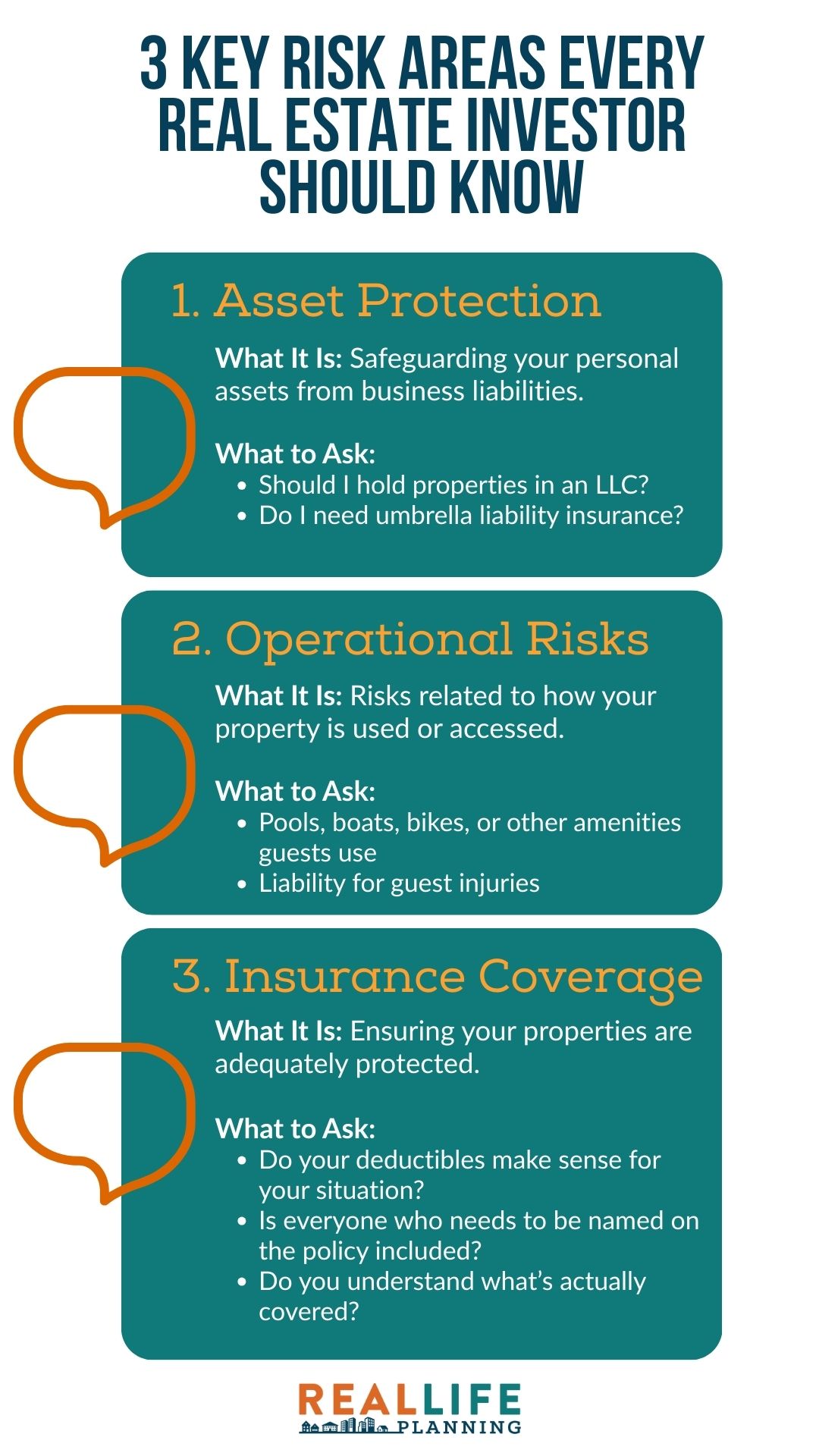
Let’s start by breaking these real estate investing risks down into 3 general categories.
The first is asset protection. Thinking about the structure of the business, does anything need to be in an LLC? Are there any other asset protection strategies that should be employed? (Think: Umbrella Liability
 , for example).
The second category would be insurance. Your financial advisor or planner should be looking at your property and casualty insurance, or your umbrella policy, making sure that you’re on the right track for your deductibles, that they make sense in your situation, and that everyone who should be named on the policy is named.
They should help you understand your policy and make sure you’re covered for all of the major risks you need to be covered for.
The third area of risk is what I like to call “operations risks”. So, in particular, if you have a short-term rental, you want to be thinking about things like liability for a swimming pool, boats, bikes, and things like that, which your guests may be using.
All of these questions should be thought through in the context of an annual risk management review.
Question #8: Will you help me evaluate financing options and lenders?
In the real estate world, there’s what you may call “plain vanilla lending” that you get from a bank or a mortgage institution, but there are lots of other ways to borrow money in the real estate space. These include things like debt service coverage ratio loans, private lending, or hard-money loans if you’re flipping a house or doing a construction project, for example.
Your financial advisor or planner should help you think through and evaluate the pros and cons of different financing options. They could even potentially help you expand your network by introducing you to different mortgage lenders.
Question #9: If I had a rental property with a large unrealized capital gain, what would you encourage me to do?
This question is about figuring out if your planner or advisor knows anything about 1031 exchanges. A 1031 exchange, or “like-kind exchange,” is a popular strategy for real estate investment tax planning. This exchange allows investors to defer capital gains taxes on an investment property by reinvesting the proceeds into a new "like-kind" investment property, given you follow the specific rules of the exchange.
If your advisor tries to convince you to sell a property and put the money in securities, triggering a potentially large taxable event, instead of using a 1031 exchange into a replacement property or Delaware Statuatory Trust, for example, you may want to seek out the agenda behind the advice.
While in some cases, this may be the right thing to do, you want to understand if the advisor is concerned more about fundraising for themselves than doing what is a more tax-efficient strategy for you as a real estate investor.
Again, there may be situations where it’s not appropriate to 1031 exchange, but you want to be sure that the person helping you doesn’t have an underlying agenda.
Question #10: What's the biggest mistake that you've made in your real estate investing journey, and what did you learn from it?
Anybody who’s been in real estate for a long time has had a situation where they had a difficult tenant or they bought a property that maybe wasn’t the right fit. They may have worked with someone on their team who wasn’t the right fit, or something else didn’t work out.
If you’re working with someone who has also been a real estate investor, this question can help you figure out if they’re humble and understand that everybody on this journey has some successes and has made some mistakes, or if they think that they know everything.
Final Thoughts
As a real estate investor, you want to make sure that your real estate financial planner or financial advisor understands the unique situations that come with real estate investing, and that they can help you make informed decisions that are in line with your goals and personal financial situation.
If you want to learn more about financial planning for real estate investors and see how our team of CERTIFIED FINANCIAL PLANNERs™ can help you, we’d love for you to schedule a call with our team.
🏠 If you have a topic you'd like us to tackle on The Real Life Blog, we would love to hear from you! Please email us at info@realifeplanning.com.
This blog is for general financial education purposes. Information contained in this blog should not be construed as financial, tax, real estate, legal, or investment advice. For educational purposes, blog posts may contain links to other websites which are not under the control or and are not maintained by Real Life Planning. Real Life Planning has provided those links for your convenience but does not necessarily endorse all the material on those sites. Please consult your financial, real estate, legal, or tax advisor for advice specific to your situation.