

What Happens When You Sell a Property After a Cost Segregation Study?
Financial PlanningBy Cynthia Meyer, CFA®, CFP®, ChFC®
What you will get from this article:
Cost segregation can be a great tax planning tool for some real estate investors, especially in the early years of owning a property.
By accelerating depreciation, a cost segregation study may allow investors to take larger deductions sooner, reduce taxable rental income, and potentially create passive losses that may support their broader real estate tax strategy.
 But there’s another side of the conversation that can be easy to overlook until the time comes: What happens when you eventually sell the property?
The same strategy that creates larger deductions upfront can also affect the tax calculation down the line. When the property is sold, prior depreciation has to be accounted for through depreciation recapture, and accelerated depreciation may be taxed differently than normal straight-line depreciation.
That’s why it’s important to understand not only what a cost segregation study can do upfront, but how it may affect your options later.
In this article, we’ll walk through what a cost segregation study does, how depreciation works, what can happen when you sell, and why accelerated depreciation may cause different tax treatment when you go to sell.
We’ll also go over some key questions to discuss with your tax professional and real estate financial planning team before selling a property where accelerated depreciation has been used.
As always, this article is for educational purposes only and should not be treated as tax advice. If you have had a cost segregation study done, taken accelerated depreciation, or are considering selling a rental property, we recommend you speak with a qualified tax advisor before making a decision.
What a Cost Segregation Study Does
 A cost segregation study is a tax and engineering analysis that breaks a real estate property into different components for depreciation purposes. Instead of treating the building as one asset depreciated over a single timeline, a study identifies parts of the property that may qualify for shorter depreciation schedules.
Normally, residential rental property is depreciated over 27.5 years, while commercial property is depreciated over 39 years. This is using straight-line depreciation, meaning the depreciable basis is spread evenly over that period.
A cost segregation study can separate certain components of the property, which may allow them to be depreciated faster. Depending on the property, that could include things such as flooring, cabinets, fixtures, certain mechanical systems, or other components that may have shorter depreciable lives.
For real estate investors, accelerating depreciation may create larger deductions in the earlier years of owning the property. Those deductions can reduce taxable rental income and, in some cases, create passive losses that fit into a broader real estate tax strategy.
That can be especially valuable for investors who have other passive income to offset or who qualify under specific rules that allow them to use real estate losses more immediately.
This upfront tax benefit is only one part of the financial planning for real estate investors. If you expect to hold the property for a long time, use the losses against other passive income, or continue exchanging into future real estate, monitoring the timing of those deductions may be helpful.
If you may sell the property later, it’s important to work with your CPA or tax advisor to understand how the depreciation you’ve taken could affect the tax calculation at sale.
Why Depreciation Matters When You Sell
Depreciation is one of the main tax benefits of owning rental real estate. In simple terms, depreciation allows real estate investors to deduct a portion of the property’s value over time to account for wear and use. It’s considered a non-cash expense, meaning it can reduce taxable rental income even though the investor is not necessarily spending that cash in the same year.
Under normal straight-line depreciation, investors take a portion of the depreciation expense each year over the property’s standard depreciable life. A cost segregation study changes the timing by allowing certain components of the property to be depreciated faster.
 Instead of waiting decades to recover the cost through annual deductions, the investor may be able to take larger deductions earlier in the ownership period through bonus depreciation rules (made permanent in the OBBBA). Depending on your circumstances, accelerated depreciation may help:
- Reduce taxable rental income
- Create passive losses
- Offset other passive income from a broader real estate portfolio
- Improve after-tax cash flow during the earlier years of ownership
Whether you can use those losses right away depends on your tax situation. Rental real estate losses are generally passive, which means they may not offset W-2 income or business income unless you qualify under specific rules, such as real estate professional status or certain short-term rental rules.
If those rules don’t apply, the losses may be carried forward instead.
The next piece is understanding what happens later. When the property is sold, the depreciation taken during ownership has to be accounted for in that tax calculation. This is true whether the depreciation was taken through normal straight-line depreciation or accelerated through a cost segregation study.
That doesn’t necessarily mean cost segregation is a bad idea; rather, it simply means the upfront deduction and the eventual sale need to both be part of your strategy.
If you’re considering selling a property where you’ve taken accelerated depreciation, the tax impact may look different than it would for a property where only straight-line depreciation was used. That’s why investors should talk with their CPA or tax advisor before listing the property, accepting an offer, or deciding whether a 1031 exchange may be a better fit.

The Three Tax Buckets at Sale
One common misunderstanding about selling a rental property is assuming the entire gain will be taxed as a long-term capital gain.
For example, an investor may think, “I bought this property for $200,000, sold it for $300,000, and held it for more than a year, so the $100,000 gain will be taxed at long-term capital gains rates.” But when depreciation is involved, the tax calculation is usually more complicated than that.
In many cases, the gain from the sale of your property may fall into three different tax buckets:
Capital gain
This is the gain you recognize from the property’s appreciation, separate from depreciation.
Straight-line depreciation recapture (Section 1250 Unrecaptured Gain)
This is the depreciation that’s taken under the normal depreciation schedule. For rental real estate, this portion is generally taxed at ordinary income tax rates, up to a 25% cap.
Accelerated depreciation recapture
This bucket applies to depreciation taken faster through strategies like cost segregation or bonus depreciation. This portion may be taxed at ordinary income tax rates (max is 37% federal bracket in 2026).
That third bucket is what can really surprise investors who have completed a cost segregation study.
Let’s say an investor buys a rental property for $200,000. They have a cost segregation study done and take $75,000 in accelerated depreciation. Over the next few years, they also take $25,000 in straight-line depreciation for other components of the property.
Later, they sell the property for $300,000 after selling costs.
While it may look like they simply have a $100,000 capital gain, because they also took depreciation, the tax treatment may be divided into three separate categories:
- $100,000 of capital gain from the increase in property value
- $75,000 of accelerated depreciation recapture, potentially taxed at the highest ordinary income rates
- $25,000 of straight-line depreciation recapture, generally taxed at ordinary income rates up to the 25% cap
Now, this is a simplified example, and the actual calculation will depend on your adjusted basis, improvements, selling costs, state taxes, suspended losses, and other details.
The main point, however, is that selling a rental property after a cost segregation study is not just about the capital gains. It also includes depreciation recapture, and investors should understand those potential tax consequences before deciding to sell.
Where a 1031 Exchange May Fit
 If an investor sells a rental property outright, the gain and depreciation recapture will typically be recognized in the year of sale. That can create a significant tax bill, especially when the property has appreciated and the investor has taken accelerated depreciation.
For investors who want to stay invested in real estate, a 1031 exchange may be worth discussing with your CPA, financial planner, and qualified intermediary before selling.
A 1031 exchange can allow an investor to defer capital gains and depreciation recapture by exchanging into another qualifying investment property. This can be especially helpful for investors who have used a cost segregation study and want to avoid recognizing those tax consequences immediately.
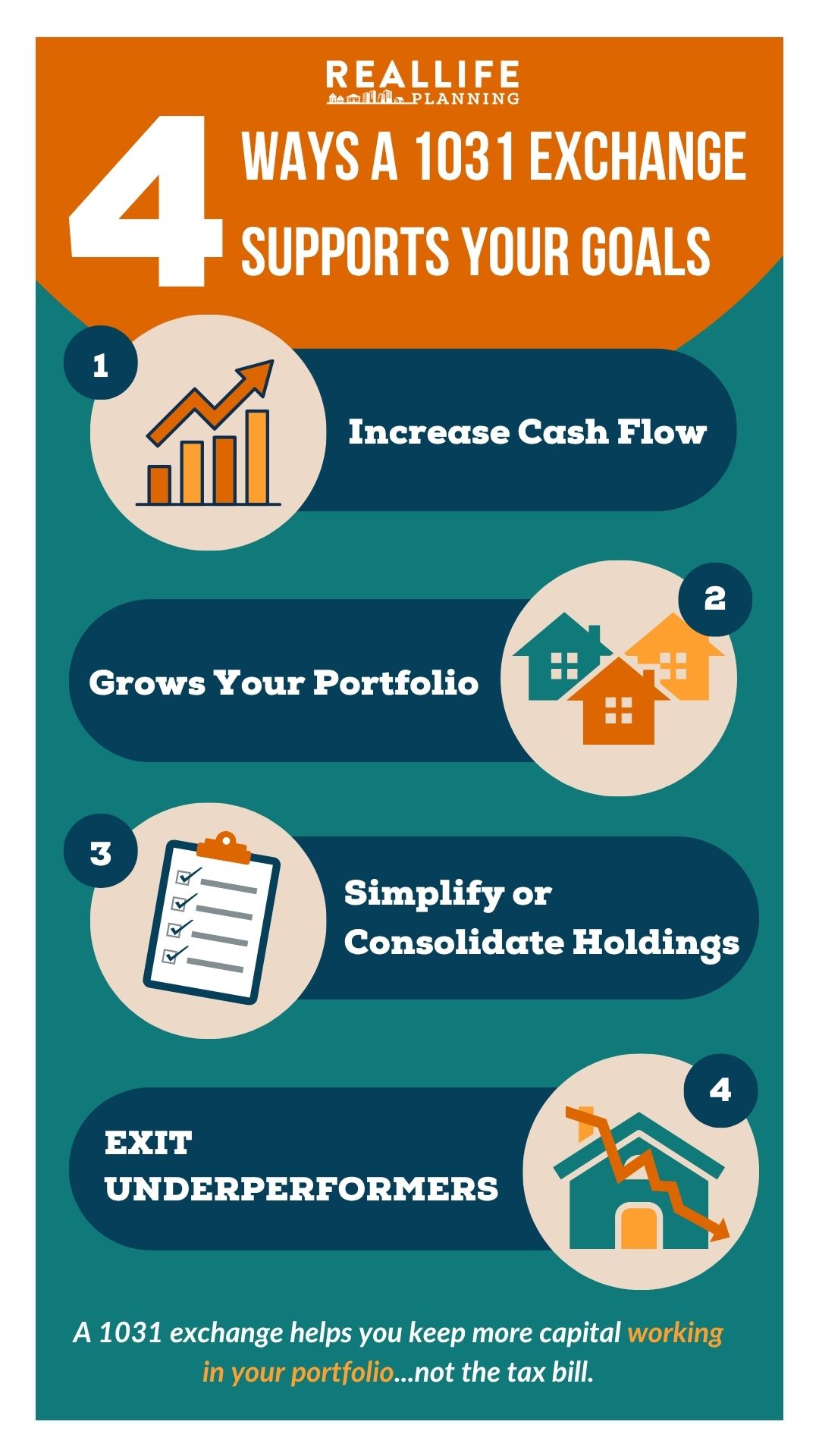
A 1031 exchange can also support other portfolio goals, such as:
- Moving into properties with higher cash flow
- Increasing the number of units or “doors”
- Consolidating or simplifying the portfolio
- Exchanging out of an underperforming property
The important thing to keep in mind here is that these gains are deferred.
A 1031 exchange does not erase the tax liability; it carries the basis and deferred gain forward into the replacement property. But for investors who plan to continue holding real estate long term, it may provide more flexibility and allow them to keep more capital working inside the portfolio rather than paying taxes at the time of sale for every property.
Questions to Ask Before You Decide
Before you do a cost segregation study or sell a property where you’ve already taken accelerated depreciation, you want to understand how all of the numbers will play out for you.
Before having a cost segregation study done — or selling a property where you’ve already taken that accelerated depreciation — you’ll want to cover a few key questions with your CPA/tax advisor and financial planning team.
Here are our top questions you’ll want to ask:
- Can you actually use the passive losses this strategy may create, or would those losses be carried forward?
- Do you qualify for real estate professional status or short-term rental strategy?
- Do you have other passive income that these losses could offset?
- How would your expected holding period affect whether this strategy makes sense?
- If you sell the property outright, what could depreciation recapture look like?
- If you use a 1031 exchange, how would that change the tax consequences?
- Does the projected tax benefit even justify the cost of the study?
- Based on the property’s actual cash flow and performance, does this still fit your overall real estate strategy?
Depreciation is a paper expense. It can reduce taxable income, but it does not change the actual performance of the property. It does not increase rent, reduce maintenance costs, improve vacancy, or make an underperforming property stronger from a cash flow perspective.
That’s why you still have to run the numbers on the property itself. Depreciation may help on the tax return, but it does not change whether the rental is cash-flowing, underperforming, or worth continuing to hold.
Planning Ahead Before You Sell
Cost segregation can be a valuable tool for real estate investors, but the upfront deduction is only one part of the decision. Before you do a cost segregation study, and especially before you sell a property where you’ve already taken accelerated depreciation, you want to understand how all of the moving pieces fit together.
That means looking at the current tax benefit, the potential depreciation recapture later, your expected holding period, and whether you plan to sell outright or use a 1031 exchange. It’s important not just to focus on lowering taxes in one year, but to make sure the tax strategy supports your investment strategy.
If you have completed a cost segregation study or are thinking about selling a property where accelerated depreciation was taken, we recommend that you talk with your CPA or tax advisor before making a decision.
For more resources on the financial and tax planning questions that come with owning a rental property business, learn more from the Real Life Blog.