

What is Appreciation in Real Estate Investing and Does it Matter?
Real Estate CoachingBy Cynthia Meyer, CFA®, CFP®, ChFC®
What you will get from this article:
In real estate investing, we hear a lot of talk about appreciation. A property that grows in value over time can help build long-term wealth, create equity, and open up future opportunities, but appreciation is also one of the easiest factors to overestimate.
A property may go up in value, or it may not. It could appreciate over the long run but stay flat for years in the short term. Renovations that you do on the property could improve the value, but it also could appreciate because of external factors in the market.
That’s why it’s important for real estate investors to understand appreciation and the role it can play in their portfolio. Appreciation could increase your equity and provide benefits over time, but if it’s the only reason you buy the property, there could be issues with cash flow that limit your upside.
What Does Appreciation Mean in Real Estate?
 When investors talk about appreciation, they aren’t always referring to the same thing. Appreciation generally means the property becomes more valuable over time, but appreciation can come from different places.
Appreciation comes first from inflation. As the cost of goods, labor, and housing rises, rents generally rise. Property values typically rise with rising rents. Rental property returns are like cooking a meal in a slow cooker: low and slow, with the best results happening over a long time.
Sometimes a property will appreciate because the overall market has changed.
Maybe there are more buyers than sellers, or maybe there’s a higher demand for housing and people want to move into the neighborhood. A new employer could be moving into the area, like an Amazon warehouse that brings in more workers. Or a Starbucks could add a location a block away, making the location more desirable.
Then there’s appreciation that comes from work done on the property itself. If you buy a property that needs work, renovate it to improve the condition, and then increase the rents or sell the property, that part of the value increase may come from the work you did to the property.
That’s why it’s important to remember that appreciation isn’t just one thing. When investors say a property may appreciate, they may be talking about inflation, long-term market appreciation, value added through renovations, or a mix of all those factors.
The key here is to remember that real estate values can rise over time, but they can also flatten, grow more slowly, or even decline for a period. That’s why investors need to understand what kind of appreciation they’re counting on and how realistic their assumptions are for the property, the surrounding market, and the overall investment strategy.
What You Can and Cannot Control
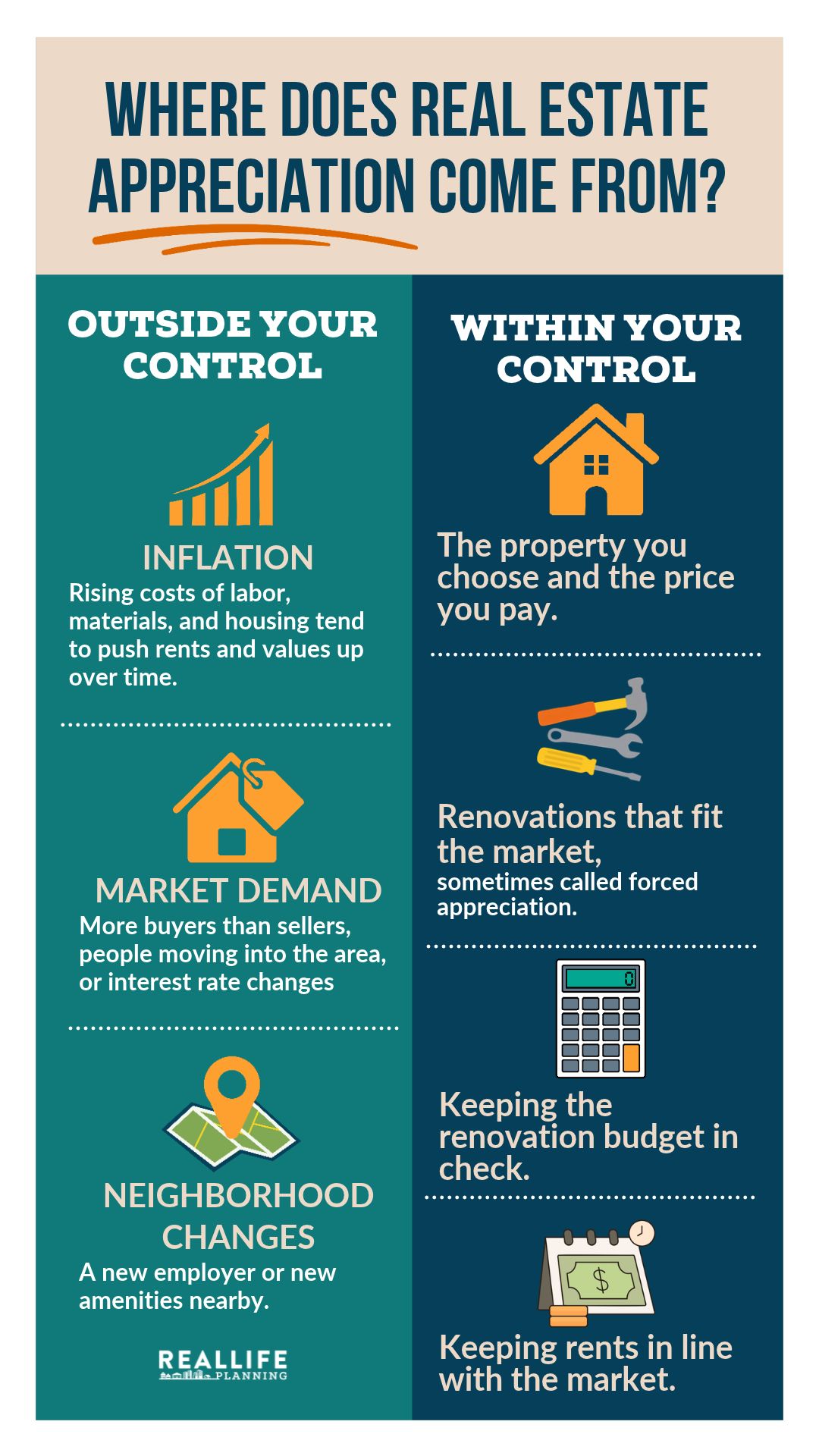 A helpful way for investors to think about appreciation is to separate it into two categories: the parts of the value you can control and the parts you cannot.
There are some things that, as an investor, you simply cannot control. You can’t control whether a major employer moves into the area or whether interest rates rise or fall. You also can’t control how many buyers are competing for homes in the market, or what the broader housing demand looks like.
What you can control is the property you choose, the price you’re willing to pay, the renovation plan, your repair budget, etc. For example, if you buy a property that needs work, you may be able to create value by improving the property, but that value will still depend on what makes sense for the market.
If you add a high-end renovation to a middle-income rental, you may not get the return to justify the money spent on the work, even if the property is nicer because of it.
You may also have some control over the income side of the property as a rental property owner. Keeping rents reasonable within the market can affect the value of an income-producing property, especially for multi-family rental properties. If you have a long-term tenant and don’t increase rents as market conditions change, the property may not be as profitable as it could be.
The main point is that appreciation can be an important part of your real estate investment strategy, but it shouldn’t be based on hope and best-case scenarios. Looking at the parts you can and cannot control can help you set more reasonable expectations for the property.
The Risk of Overestimating Future Value
With the higher-than-normal inflation in recent years, it can seem like a property will appreciate very quickly once you buy, but it’s important to understand that it’s unrealistic to expect the same rate of appreciation to continue for years to come.
A market that’s recently seen double-digit growth may have historically appreciated at a much lower rate. Even in markets that perform well long-term, prices don’t always go up in a straight line.
This tells us that investors should use more realistic assumptions before buying a property and banking on future value. If you’re estimating future appreciation, look at what’s normal for the area over time, not just during an unusual period of rapid growth.
Appreciation Through Renovations
 Now that we understand that some parts of appreciation are out of your control as an investor, let’s look at some ways that you can add value to your property.
Renovation based appreciation - sometimes called “forced appreciation “ - is when you increase the value of a property through the choices you make. That might mean buying a property that needs love, renovating it, and selling it at a higher price or increasing rents.
This can be a valuable strategy for investors who are willing to take on the risk of the project. By improving the property and managing the project carefully, you may be able to create instant equity in the property instead of waiting for the market.
However, it’s important to make sure the numbers work on your side. Spending money on a renovation doesn’t automatically mean the property value increases by that same amount. If you budget $20,000 for improvements but end up spending $50,000, the appraiser or future buyer isn’t going to increase the value just because you went over budget or chose to renovate something that doesn’t return 100 percent of the cost.
The improvements also need to match the property, the neighborhood, and the target renter or buyer. Higher-end finishes may help a property rent or sell more quickly, but that doesn’t always mean the market will support a high enough value to justify the cost.
This is where we advise investors to be careful. Renovation based appreciation can work, but you have to understand the likely after-repair value (ARV), keep the renovation budget under control, and make improvements the market will actually reward.
After-Repair Value and Why it Matters
After-repair value, or ARV, is the estimated value of the property after renovations are done. This is something investors look at if they’re flipping a property, using the BRRRR strategy (Buy, Rehab, Rent, Refinance, Repeat), or planning to refinance the property once the work is done.
As an investor, you want to make sure that buying, acquisition, and repair costs aren’t more than the ARV.
ARV estimations should be based on recent comparable sales, not just what you hope a property will be worth. You may have to look at similar properties in the area that have recently sold and ask whether they support the estimated value you’re using.
Looking at comps may be easier for single-family homes than for multi-family properties, where there may be fewer comparable sales in that area and an appraiser may have to look across a wider area.
Having the right questions for a listing agent can help you understand what that value could look like. The numbers they’re giving you may be based on the property’s current sale price, not necessarily the value after renovations, so asking for comps may help you understand if a property can reasonably be sold at the future ARV you’re basing assumptions on.
This can be especially important if you plan to use the BRRRR strategy, since the refinance depends on the property appraising high enough after the work is complete. Rising interest rates can also affect whether the numbers still work, even if you create equity through the renovation.
As the project moves forward, keep checking the market; new sales may give you better information about what the property may be worth when the work is complete.
How Cash Flow and Appreciation Work Together
Appreciation can be an important part of building wealth through real estate, but it’s not the only number that investors need to think about.
Your property may increase in value over time, but you still need to own and operate it along the way; cash flow, reserves, debt, repairs, vacancy, and capital expenditures all still affect the property’s profitability.
For rental property owners, a property should, at the very least, be marginally cash-flow positive. Investing in an attractive neighborhood doesn’t necessarily make up for a property that starts out with a negative cash flow.
This is especially true when there’s leverage involved. Debt can help you buy more property and preserve your cash reserves, but it can create risk if used too aggressively. On the other hand, tying up too much cash in one property can also limit your flexibility. This is one way lenders can contribute to the value conversation. If the numbers don’t work for the bank, that may be a sign to review whether they’ll work for you.
Appreciation also needs to fit into your broader plan. Equity is real wealth that shows up on your balance sheet, even if you’re not immediately converting that value to cash or refinancing.
Some investors may continue holding a highly appreciated property for long-term wealth or intergenerational planning. Others may refinance, sell, or use a 1031 exchange to move into a property that better supports their current goals. In some cases, you may also need to revisit rents if they’re far below market and affecting your property’s income potential.
Appreciation and cash flow are both important parts of the equation, but it’s important to understand how they work together and the role they each play in your real estate investment strategy.
Looking at More Than Appreciation
Appreciation is one of the reasons that real estate can be such a wealth-building tool. Over time, a property can become more valuable and create equity that gives you more options as an investor. That equity may support a future refinance or sale, a 1031 exchange, a long-term income plan, or a generational wealth strategy.
But appreciation is only one part of the equation. Some appreciation comes from market factors that you can’t control, while some may come from improvements you make to the property. Either way, the assumptions about the property’s future value need to be realistic.
Before you solidify the numbers, you should understand what kind of appreciation you’re counting on and how those assumptions are playing out in comps in the market. You also want to understand what your cash flow may look like so that it can make sense for you while you own it, not just when you go to sell.
If you want help understanding how appreciation, cash flow, equity, and your rental properties fit into the rest of your financial plan, reach out to the Real Life Planning team to see how we may be able to support you.