
How to Buy a Rental Property With Less than 20% Down
Real Estate CoachingWhat you will get from this article:
If you’ve been thinking about buying your first rental property, the down payment may be one of the first big obstacles that comes to mind. Whether you want to get your first property to house hack, or you want to live in a property for a few years, then rent it out later, the typical 20% down payment requirements can add a hurdle to the process.
But did you know that you can purchase your first property without having to put 20% down? Not every path into real estate investing starts with a traditional investment property loan. For some investors, an owner-occupied loan with a house hacking strategy can create a more accessible way to get started.
In this article, we’re going to talk about options that allow people to get started as homeowners and real estate investors with less cash up front.
What Types of Loans Require Less Than 20% Down?
There are a few options that allow real estate investors to purchase that first property with a lower down payment. The most popular option is an FHA loan or a conventional loan. The best option for you will depend on a few different factors, including:
- Your credit score
- How much you have saved to put as a down payment on the mortgage
- Your debt-to-income ratio
- Your overall financial goals
While the typical down payment that investors save for is 20%, a conventional loan can allow you to put as low as 3% down, while an FHA typically requires 3.5% down.
Conventional Loans vs. FHA Loans
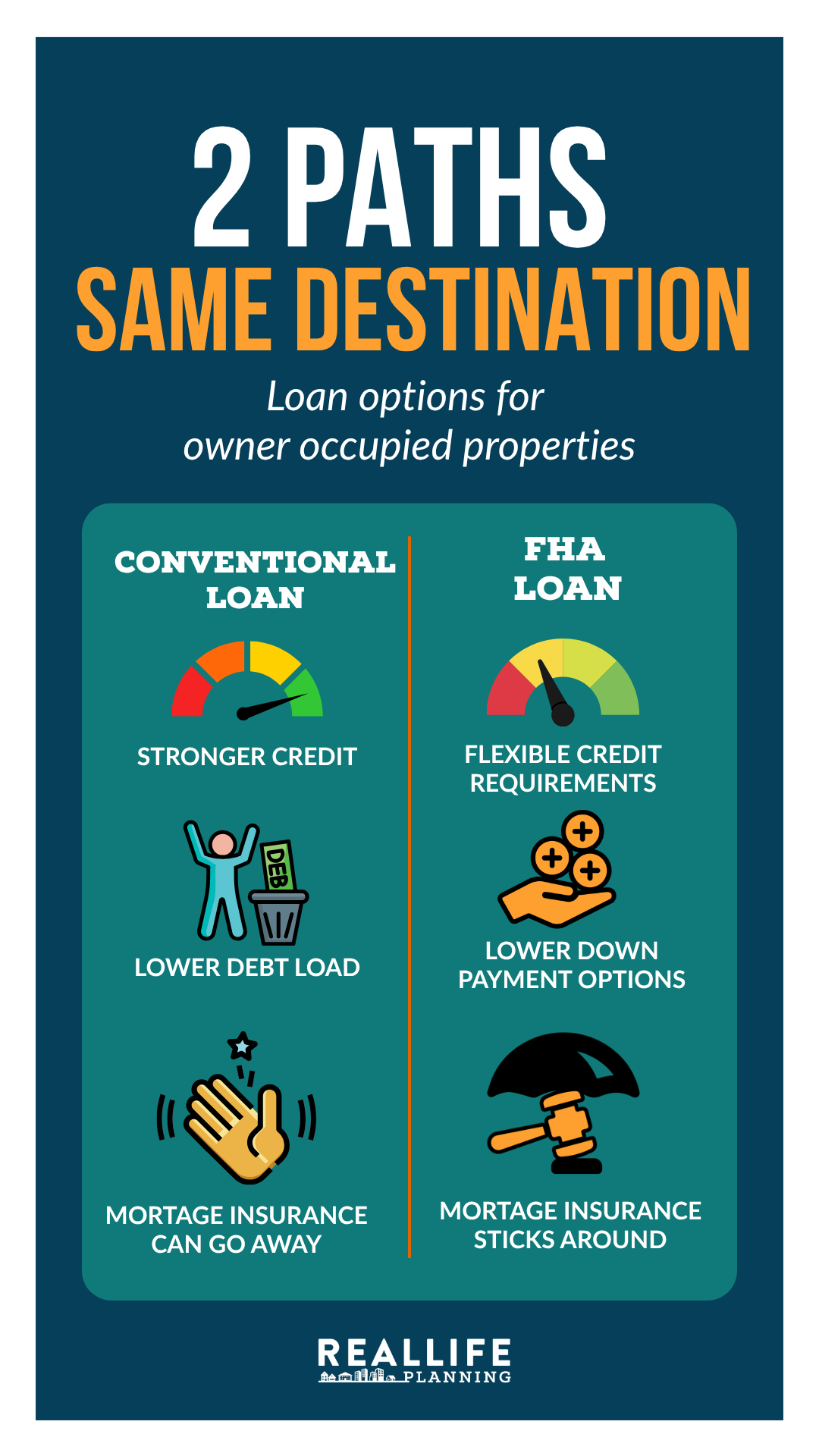 Conventional loans are typically better suited for individuals with a decent credit score (680 or above), with a low ratio of debt to the amount of income they bring home. Since these individuals are considered more financially stable from a lender’s perspective, they can sometimes qualify for the loan with a 3% down payment.
There are some factors to keep in mind if you go this route, however. With a conventional loan, putting less than 20% down usually means paying private mortgage insurance (PMI). PMI is an added cost that protects the lender if the borrower stops making mortgage payments.
Fortunately, once you’ve paid at least 20% of your mortgage, you can get rid of the PMI and don’t have to pay that additional cost anymore.
FHA loans, on the other hand, are insured by the Federal Housing Administration (FHA) and may offer more flexible credit and down payment requirements than some conventional loans. Buyers with a credit score of 580 or higher may qualify for a down payment as low as 3.5%, though each lender’s requirements can be different.
FHA loans also require mortgage insurance premiums, which add to the cost of the loan to help protect the lender if the borrower defaults.
Unlike with PMI for conventional loans, the mortgage insurance premiums with an FHA loan are there for the life of the loan, and you can only get out of that by refinancing into a conventional loan. In fact, with an FHA loan, this applies even if you do put 20% down.
Which Loan Type is Best For You?
The right loan type for you is going to be heavily dependent on your situation.
Since the mortgage insurance premiums function differently than PMI for a conventional loan, it makes more sense in many cases to go with a conventional loan if you have that 20% down payment. However, if you have a lower credit score or a higher debt-to-income ratio, an FHA loan may offer more flexibility and help you qualify for a property when a conventional loan may be harder to qualify for.
Keep in mind that, whichever loan type you choose, a lower credit score will typically mean a higher interest rate on the mortgage.
Can You Still Rent Out a Unit with Owner-Occupied Loans?
 One of the most important things to understand about these lower-down-payment options is that they are generally designed for owner-occupied homes. That means you’re buying the property as your primary residence, not as a traditional investment property.
But that doesn’t mean the property cannot produce rental income.
For example, a conventional loan or FHA loan may work for a single-family home where you rent out a room now an/or convert the property to a rental later, as long as you follow the loan’s occupancy requirements.
These loans may also be used for certain small multifamily properties, making traditional house hacking an entry point for new real estate investors.
House Hacking with Less Than 20% Down
House hacking is a strategy where you buy a property, live in part of it, and rent out another part. For example, you might buy a duplex and live in one unit while renting out the other. Or you might buy a triplex or fourplex, live in one unit, and rent out the remaining units.
Usually, real estate investors can use either a conventional loan or an FHA loan to house hack. You can actually get up to a four-unit property using one of these loans. The rules and process tend to be a bit easier for a four-unit house hack with a conventional loan, but either option may technically work.
This would allow you to invest in a property for that 3% or 3.5% down payment, as long as you follow the rules of the loan and plan according to the owner-occupancy rules.
While this option adds additional complexities, like considering income generated from other units when qualifying for the mortgage, this may create an opportunity for investors to get into a house hack without having to pay 20% down.
You May Not Need 20% Down to Start Investing in Real Estate
 Many real estate investors assume they need a 20% down payment before they can buy a home and 25% down payment to buy a rental property. For some investors, that may be the right path, but it’s important to know that it’s not the only path.
Depending on your situation, a conventional loan or an FHA loan may allow you to purchase a property with less than 20% down, though there are additional considerations (like insurance premiums) that may apply. This can make real estate investing feel more accessible for newer investors.
It’s important to look at all of the factors before deciding on financing for your new property, and to recognize that there’s more to the process than trying to make the lowest possible down payment. The right option for you depends on what would work best within your financial plan.
If you’re considering a lower-down-payment strategy to buy your first rental property or house hack, it can be helpful to talk with a qualified mortgage professional and a real estate financial planner to make sure you understand the full picture before taking the next step.